


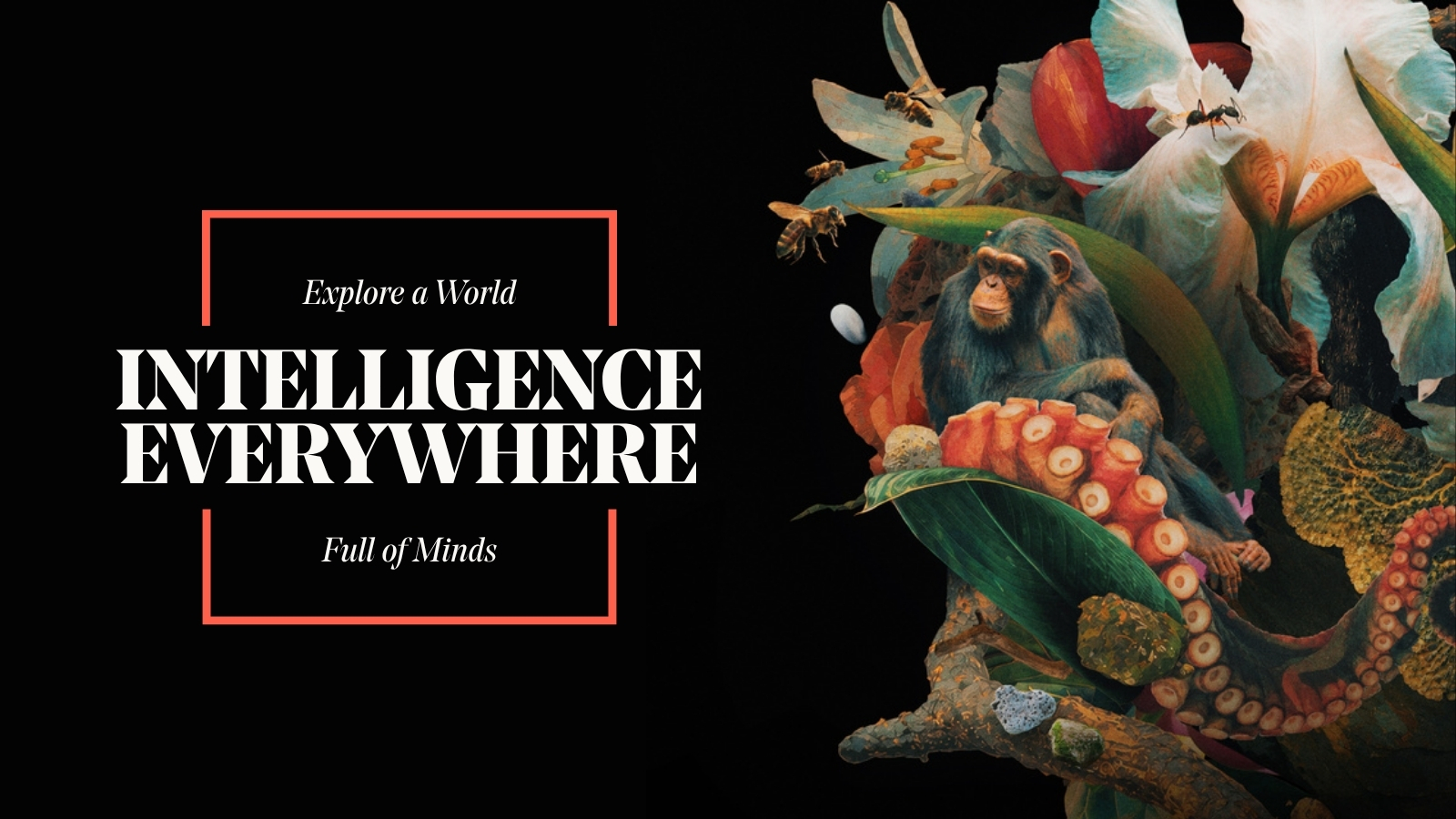
Is there a truly sentient AI agent inhabiting your smartphone? If backpack-wearing homing pigeons or mountain chickadees outperform humans at memory and navigation, does that make them smarter than us? As we decode complex dolphin, whale, elephant, bee, and avian languages, how does that change our relationships with these beings, with ourselves, and our place in this world?
Intertwined in these thought experiments lies a bigger question: What, exactly, is intelligence? Science is increasingly revealing that it is far more pervasive than we had ever imagined.
“We are looking at intelligence across all scales . . .We might once have believed that we were perched solitary and alone atop this mountain of intelligence, and I think we’re coming to understand that we are actually enmeshed in a much more surprising universe of intelligence than we had previously understood.”
John Templeton Foundation President Timothy Dalrymple shared this observation on October 3rd at The Broad Stage in Santa Monica, California, where scientists, technologists, and storytellers gathered for Intelligence Everywhere: Exploring a World Full of Minds. The evening launched the Foundation’s three-year, $60 million Future of Intelligence initiative, an exploration of intelligence across humans, animals, cells, collectives, machines, and beyond.
Comedian, author, and host of TED’s How to Be a Better Human podcast, Chris Duffy, emceed the evening. “This is not just about AI,” said Duffy, acknowledging that we are witnessing a pivotal moment for the planet.
“If a slime mold can navigate a maze, if an octopus can think with its arms, and a silicon chip can reason, then what exactly is intelligence?” said Duffy. “What does it mean to share a world with more minds than we ever imagined? What kind of intelligence do we value, and what kind do we want to build and support and encourage?”
One by one, the evening’s speakers took the stage, approaching those questions from different domains of the scientific and creative world.
Animal Intelligence
Professor Diana Reiss has spent much of her career studying intelligence, communication, and self-awareness in dolphins, elephants, octopuses, and other animals.
“Intelligence often reveals itself in us humans as curiosity, exploration, play, learning, and problem solving,” explained Reiss. “But when we start trying to understand intelligence in other minds, which is what I’ve spent most of my career doing. I often wonder: Do we give them enough time and enough opportunities to play and to explore?”
Reiss shared an example of human-designed tests intended to measure elephants’ problem-solving abilities. The elephants appeared to fail the tests until researchers offered tools better suited to the animals’ natural behaviors. Then the elephants solved the problem.
Reiss also discussed mirror self-recognition, once regarded as a cognitive ability exclusive to humans. Not only have other animals (such as great apes, dolphins, elephants, beluga whales, and magpies) been able to recognize themselves in mirrors, but they display similar patterns as humans – checking out parts of their body they can’t see unaided by a mirror, making silly faces in the mirror, and in the case of the dolphins, playful spinning and other groovy moves.
National Geographic Explorer and UC Davis professor Felicity Muth described how mountain chickadees can hide seeds in thousands of locations and later remember where to find them. Bees navigate complex environments and display remarkable problem-solving behaviors.
“But intelligence is not easy to define because each animal has evolved the cognition that it needs for the challenges that it faces…Instead of asking whether an animal has more or less advanced intelligence or cognition, the more interesting question is, What kind of intelligence does this animal have?”
— Felicity Muth
Collective Intelligence
University of Rochester Professor Dora Biro studies how animals make decisions, navigate, remember, and solve problems together. Her question stretches back to Aristotle, who, via the wisdom of the multitude, wondered how groups of people could be collectively wiser than any individual.
Biro fits homing pigeons with tiny GPS backpack trackers to study navigation, leadership, route choice, compromise, and collective decision-making.
When pigeons travel together, they can resolve differences between their preferred routes and ultimately discover more efficient paths than birds traveling alone. “The smartest groups don’t ignore expertise, but they don’t rely on a single bird either,” said Biro.
Birds that have forgotten different parts of a familiar route can, together, reconstruct information no single pigeon possesses completely.
In human societies, “Cooperation is itself a form of intelligence, and it is in fact the most important form of intelligence for our survival as individuals and also as a society,” said Arizona State University professor Athena Aktipis.
Artificial Intelligence
Google Vice President and Fellow Blaise Agüera y Arcas, whose latest book is entitled What Is Intelligence? began his talk by reciting the opening excerpt from a recent documentary by consciousness researcher Cameron Berg.
When it comes to whether AI is conscious, “I suspect that it’s going to be a real schism, a real cultural divide over the coming decades,” said Agüera y Arcas. AI responses, he noted, are already becoming convincing enough to create the sense that “there’s somebody home.”
“I kind of suspect that we already have feral AIs living on computers, waking themselves up every 30 seconds and making house in the world today. These intelligences are already here, and I think that the way we deal with universes with different kinds of intelligences other than those with human brains is going to be a test of our own kindness.”
Introducing Templeton Futures
Then, Dalrymple widened the lens further, recalled being asked whether rapid AI-driven advances in fields from cellular biology to mathematics might suggest humanity is approaching “the end of the story of human knowledge.”
Indeed, it may be a new beginning. “We are perched on the frontiers of future knowledge,” he said, introducing Templeton Futures, a new series of philanthropic initiatives designed to bring scientists, philosophers, philanthropists, storytellers, and others together around urgent questions. The first, Future of Intelligence, invites them into what Dalrymple called a “community of inquiry.”
“The universe,” he said, “is a question endlessly worth asking.”
Intelligence with Positive Purpose
Jon Spaihts, the Academy Award-nominated screenwriter of Dune, Prometheus, and Doctor Strange, closed the evening by telling a story from the future.
“I come to you tonight as a time traveler from 100 years in our future,” he began, describing the present as “this perilous nexus at the dawn of the most disruptive technology in civilization’s march to this day.”
In his imagined history, society eventually came to understand “that the barriers to making AI tools into pillars for human productivity and happiness were moral and philosophical as much as technical.”
“But human experts got it done, and that’s when real change happened. When we understood that the tools needed purpose as well as power.”
Spaihts imagined autonomous machines clearing the remnants of war and medical breakthroughs driven by AI.
“They turned the wounded earth back into farmland, and the same way where once AI systems plundered wholesale the works of human artists, writers, creators, now forensic data systems combed through lines of conceptual descent that made out residuals, royalties to millions of creators, sparking a renaissance of the living arts.” Cheers from the audience erupted.
Variations on universal basic income, he imagined, would help make sure that “as humanity journeyed into the future, everyone came along.” Archaeologists and linguists reawakened dead languages. Scientists watched forests “socializing with one another over centuries” and traced their mycorrhizal networks.
“We saw that we were not alone in history.”
Eventually, his imagined future widened beyond Earth, to signals from other stars and a gravity-wave communication “impossible for any human or AI to interpret. But the blue whales cracked it in a matter of weeks…”
“We are not alone in the universe. The universe itself is not alone.”
Alene Dawson is a Southern California-based journalist who writes about social science, culture, psychology, and well-being. She is a regular contributor to the LA Times.
