

A long time ago (in 1977), in a galaxy far, far away (at your local theater)…a young farmworker, Luke Skywalker, destroyed a planet-exploding super weapon. At age 20 (in 1980), he discovered how the weapon’s existence was related to his true parentage. Twenty years earlier (in 2005), Luke and his twin sister Leia were born. At age 53 (in 2017), Luke died.
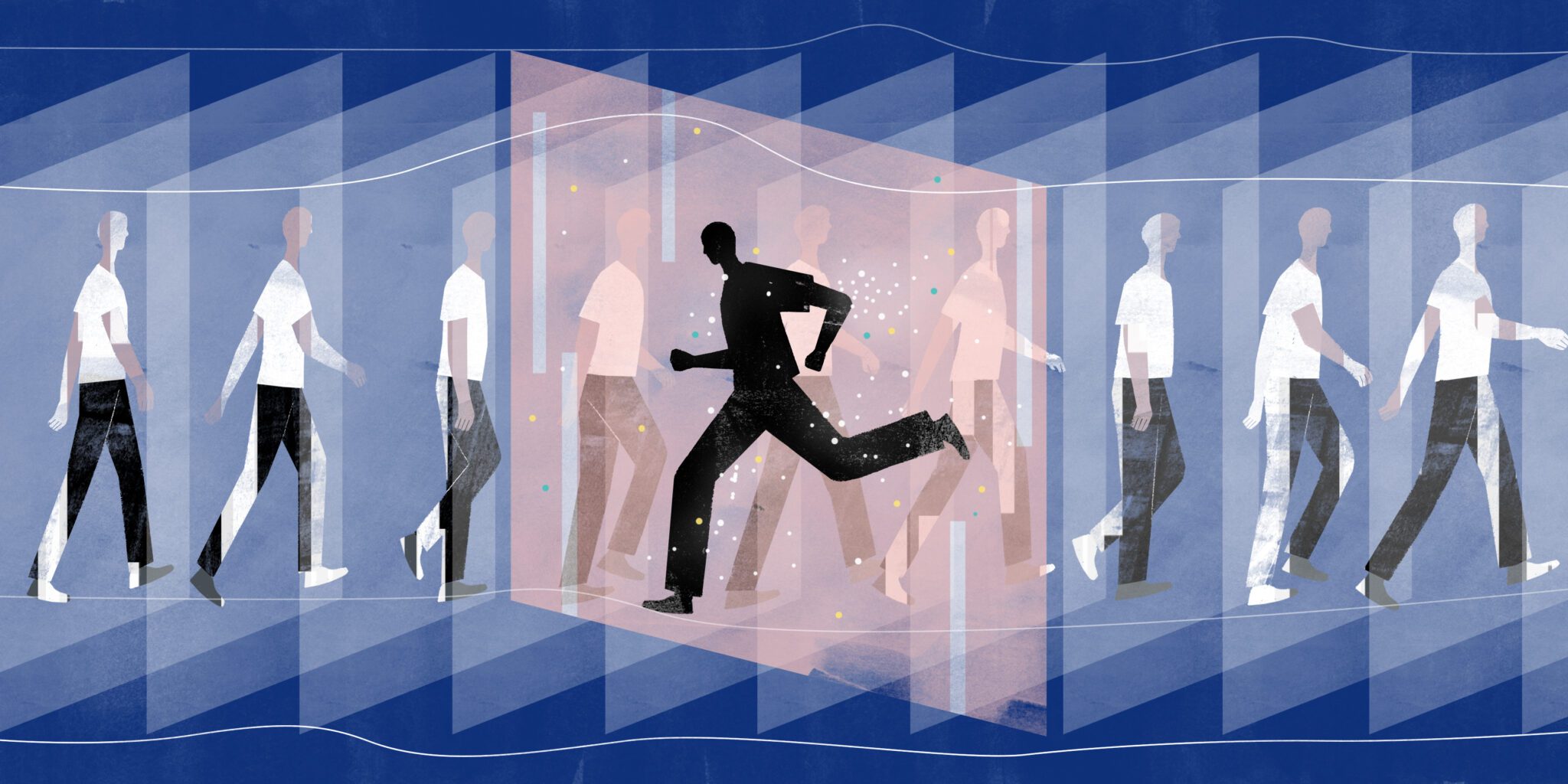
This (still unfolding) saga of the Jedi, the Empire, and the extremely dysfunctional Skywalker family is encoded in almost 50 years’ worth of film and digital media. Frame by frame, the story of their complicated history emerges. Viewers piece together the causal order of events, scattered across multiple locations in a fictional universe, which will ultimately lead to the fall of the evil Empire—despite the fact that the frames of film that record this narrative were presented to the audience out of temporal order.
But what of the story of our universe? Is it possible to piece together how not just the events that happen within our universe occurred,
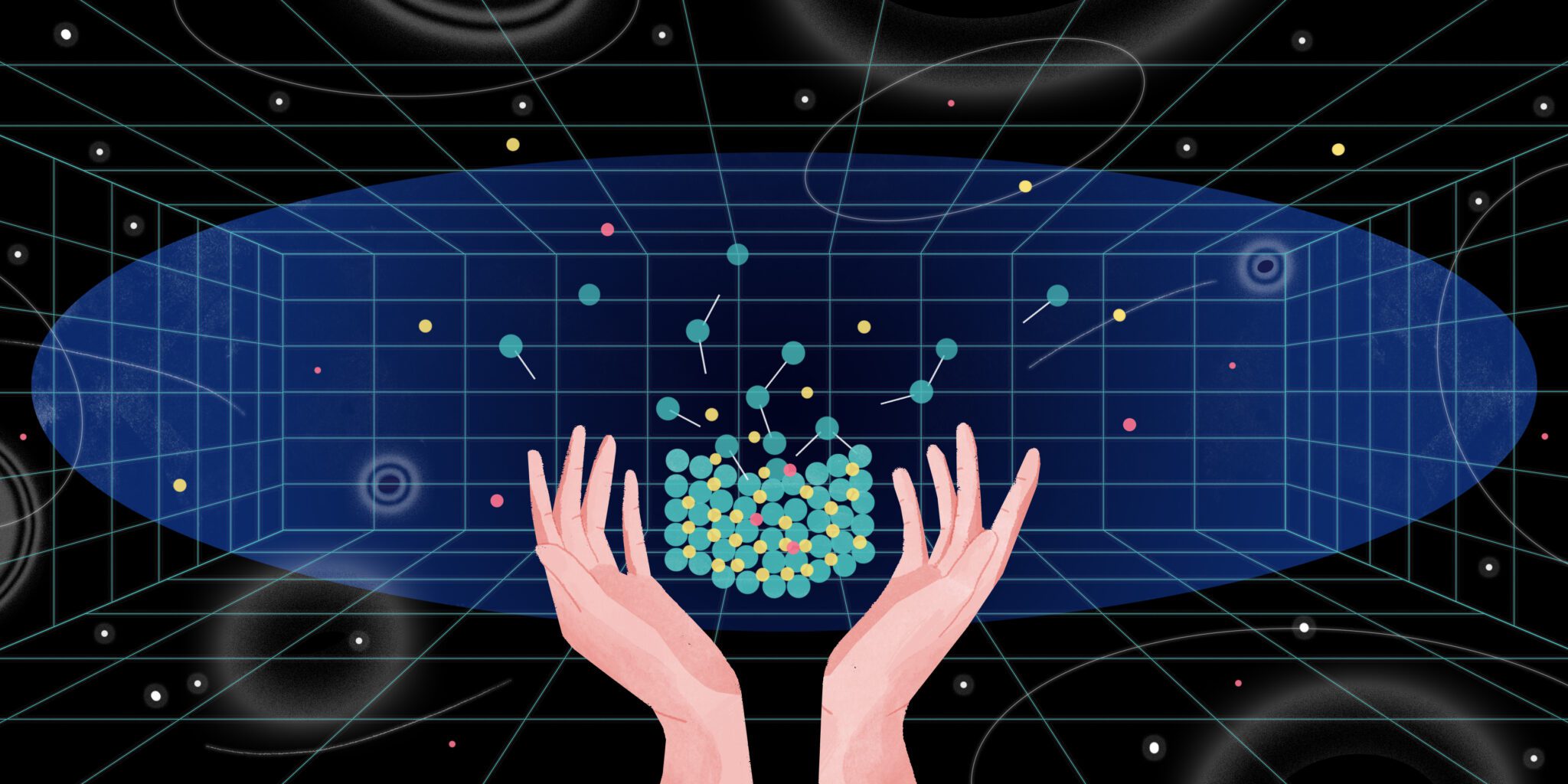
but how space and time are encoded in, and emerge from, some more fundamental “atoms” that are themselves devoid of spatial and temporal extent?
These are questions that philosophers of physics Nick Huggett, of the University of Illinois, in Chicago, and Christian Wüthrich, of the University of Geneva, in Switzerland, tackle in their recent book Out of Nowhere. They discuss three of the best-known candidate theories that attempt to uncover the foundations of reality: causal set theory, in which spacetime is built from points representing events; loop quantum gravity, which spins a spacetime web from geometrical threads; and finally string theory, which suggests that our concept of spatial size may have a deep and complex relationship with tiny vibrating strings of energy.
Connect the Dots
What might such building blocks of spacetime look like? The first possibility discussed by the authors is causal set theory, which conceives the seeds of reality to be “events”—points that we would understand as existing at a certain place in space and in time, but stripped of their temporal and spatial coordinates. These events can be drawn as dots on a diagram, with lines linking dots that have a causal relationship. If event A causes event B to happen, then dot A will be drawn lower on the diagram, with a line linking A to B. Thus, a few events can spawn a growing network, like branches on a tree, together generating space-time.
One major feather in casual set theory’s cap is that it predicted that our universe’s expansion should be speeding up, about ten years before astronomers discovered that this is indeed the case. This is because, in causal set theory, the volume of spacetime, growing from an ever-increasing number of events, fluctuates, creating an intrinsic energy that pushes its expansion outwards. Even more intriguingly, back-of-the-envelope scribblings in the 1980s suggested that the amount of this push would be tiny but measurable. A decade later, astronomers studying the motion of supernovae were shocked to discover that the universe’s expansion is accelerating—tantalizingly in line with this predicted rate.
Huggett and Wüthrich raise the slightest of eyebrows at the claim that dots defined by their causal relationships can truly be said to be entirely devoid of any concept of time, however. You might try an analogous trick, cutting up the frames of the Star Wars films, scattering them on the floor, and then ordering them in terms of cause and effect (the moment that Luke and Leia’s parents first meet must lie lower in the causal diagram than the twins’ births, for instance). It is true neither the individual frames nor their ordering contains a temporal flow, but they do contain an implicit sense of time.
On the flip side, the dots really do seem to lack spatial extent, making it tough for the theory to explain how a concept of space can emerge from the growing set of causal dots. Back to Star Wars, you may be able to understand by looking at the frames of our story that teenage Luke and teenage Leia meet after having been separated at birth, but there is not enough information encoded in the frames to map out how distant their respective fictional home planets are from each other. (A Google search tells me Luke’s Tattooine and Leia’s Alderaan were 50,000 light-years apart.)
Weaving Threads
Causal set theory, then, is still a work in progress, with no easy explanation for how space emerges from its dots. Another weakness is that it doesn’t incorporate any of the famed peculiarities of quantum physics in its setup. Not so for the next theory under consideration, loop quantum gravity, which claims that the fabric of spacetime is actually a net woven from quantum loops, just as your shirt—which may seem to be cut from one continuous piece of cloth when viewed from afar—can be seen to be composed from individual threads when you peer in more closely.
In the quantum world, this very act of peering brings some additional twists. For starters, a defining feature of quantum theory is that when you zoom right down, you’ll find there is a fundamental limit to how tiny things can ever become: there is a smallest chunk of energy that can exist, a smallest area, and a smallest volume. It’s difficult to picture, but the abstract geometric net that makes up spacetime in loop quantum gravity has nodes that represent this single smallest unit of quantum volume, joined by lines representing the smallest allowed area in quantum physics.
Another bizarre feature of quantum physics is that at the smallest scales, things become fuzzy: before you look at them, for instance, particles can exist in two places at once, only snapping to one definite position when you measure their location. Similarly, the networks of loop quantum gravity can have multiple configurations at the same time. The idea is that our spacetime emerges as the elements of the network interact, effectively “looking” at each other, breaking the quantum blurriness, and forcing themselves into a set state.
The Problem of Time
Thanks to having distance built into its foundations, it’s much easier to accept that space, as we know it, could somehow emerge from quantum loops. What’s more confusing is how time arises from the network. This turns out to be a problem for all physicists who attempt to stick the equations of quantum theory together with those of relativity—in so doing, the time variable in both sets of equations cancels out, creating an equation of quantum gravity that describes a frozen universe that contains no time variable, and thus doesn’t seem to have any capacity to change.
Over the years, physicists have interpreted this “problem of time” to suggest that the equations of quantum gravity provide an external view of the universe, from a perspective outside of time. Within the cosmos, participants can experience the evolution of time, but only in relation to other objects in the universe, not against any external physical clock. At the risk of belaboring the Star Wars analogy, from the point of view of a fan holding the Blu-ray box set of all nine films, the Skywalker saga is a completed, unchanging tale; but from the point of view of Darth Vader, in Episode 4, it is very much an evolving story, with his fate yet to be decided.
The Holographic Universe
The final portion of the book turns to probably the best-known candidate for a fundamental framework of reality: string theory, which posits that elementary particles and forces can all be described by tiny strings of energy. At this point, keen readers of popular physics may expect the book to tread a well-worn path and describe how, over the past two decades, many string theorists have become increasingly fascinated by the idea that the universe could be thought of as a “hologram,” with our 3D space emerging as a projection of quantum information and interactions encoded in a lower-dimensional space. But in a plot twist, Huggett and Wüthrich turn instead to an earlier result in string theory—a prequel duality as it were—which revealed that using string theory’s math, it is weirdly impossible for us to tell the difference between living in a huge expanding universe or a tiny shrinking cosmos; both would appear large and growing to its inhabitants.
The authors conclude that this ambiguity implies that space, in a stringy world, cannot be fundamental.
Out of Nowhere doesn’t play favorites: each of the three theories discussed in the book is presented as a work-in-progress, and none of the trilogy of causal set theory, loop quantum gravity, or string theory has all the answers. But with their rigorous analyses, Huggett and Wüthrich successfully make the case that there are strong reasons to believe that space and time are emergent—even if we don’t yet know the mechanisms behind them. That said, the lack of an in-depth discussion of holography is a shame (not least because it robs me of a chance to work Princess Leia’s holographic projection from R2D2 into this review). This highly speculative, yet popular program could benefit from their incisive scrutiny. But perhaps, as with the creators of many other good sagas, the authors are saving that topic for the sequel.
Zeeya Merali is a London-based science journalist and author of the popular physics book, A Big Bang in a Little Room.