


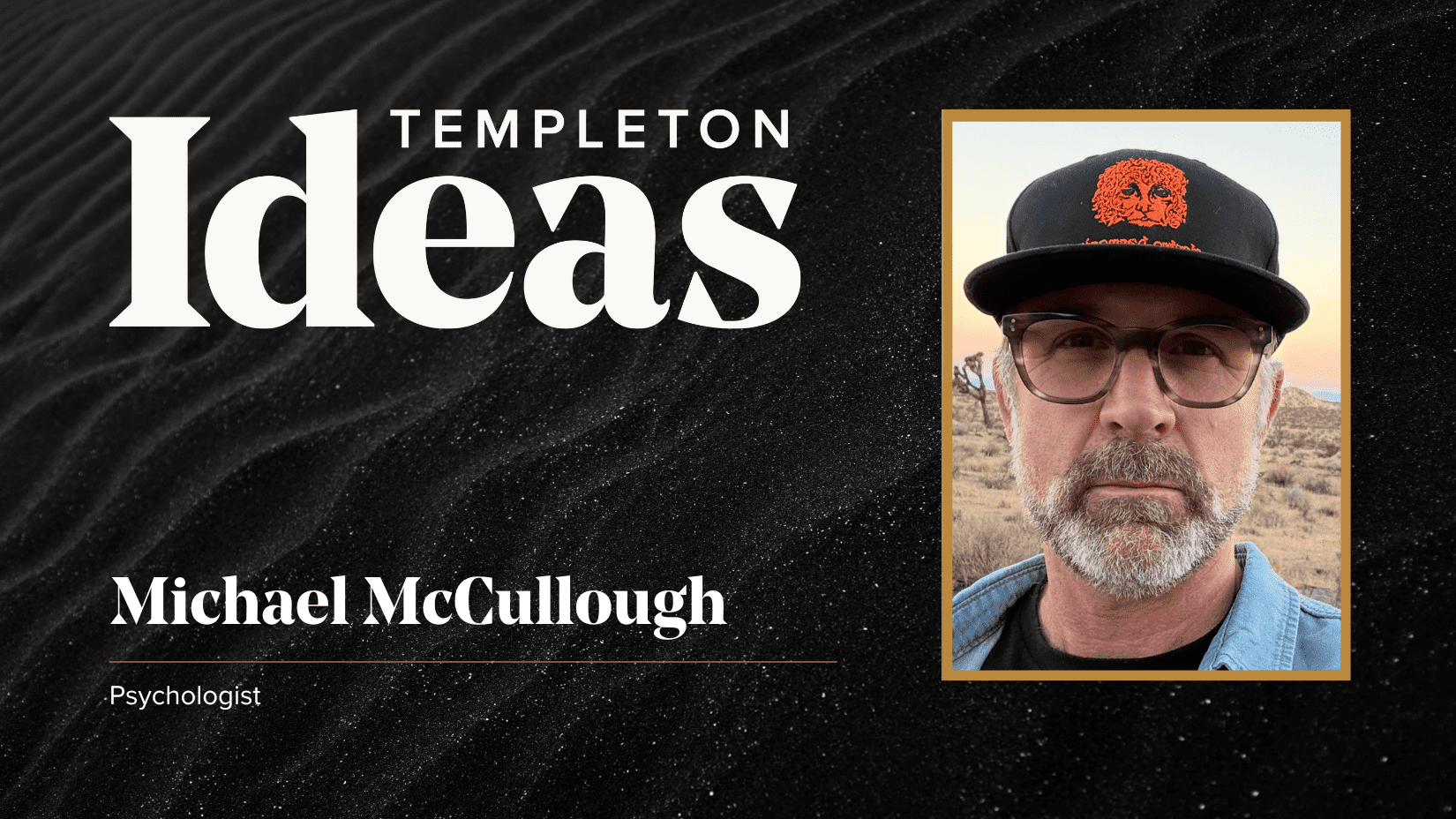
Michael McCullough is a psychology professor at UC San Diego who explores the ways our evolutionary past illuminates how humans today think, feel, and behave. For 25 years, he has pioneered experimental work on forgiveness, gratitude, empathy, religion, and morality. With the support from the Templeton philanthropies, he directs an international effort to better understand the role of gratitude in many different cultures. Among his many publications, Mike has authored the book The Kindness of Strangers: How a Selfish Ape Invented a New Moral Code, as well as Beyond Revenge: The Evolution of the Forgiveness Instinct. Mike joins the podcast to discuss forgiveness, revenge, and our evolutionary and cultural tendencies toward each.
In the aftermath of apartheid in South Africa, it’s hard to imagine how they could rebuild the fabric of their society–and yet they’ve done so through an arduous process of truth and reconciliation. To learn more, check out the Templeton Ideas essay Beyond Forgiveness: The Reparative Quest in South Africa, featuring Templeton Prize winner Pumla Godobo-Madikizela.
Transcripts of our episodes are made available as soon as possible. They are not fully edited for grammar or spelling.
Thomas Burnett: Mike, welcome to the show.
Michael McCullough: Thanks for having me, Tom.
Thomas Burnett: I’d like to know about your kind of early intellectual curiosities. Were you a book reader? Were you like an amateur naturalist? Where did your intellectual curiosity take you?
Michael McCullough: I read the same stuff all other kids read, like detective books and I was interested in archeology and I’d get on a kick where I wanted to understand Michelangelo better or I wanted to understand Beethoven better and I’d go get some records at the library.
I think I just wanted to understand the world of books and thinkers and, high culture.
Thomas Burnett: Yeah. What was your mindset when you headed to college? Do you have a certain kind of education in mind or a certain career goal in mind?
Michael McCullough: Yeah, I wanted to be a pastoral counselor actually. So for those of you who don’t know what that is, that’s a counselor that does a combination of psychology and soul care often in the context of churches or in the context of religious organizations.
So I went into psychology, but I discovered I was better at research. Than at actually the people part of being a psychologist. So it was probably about my third year of college. I knew that, yeah, I’m going to go into psychology and I think I want to make a contribution to science
Thomas Burnett: Turning to research, diving deep, so many different fields even within psychology, did you have a certain mentors or people that helped guide you down certain paths or help you find your way?
Michael McCullough: Absolutely. I’ve always sought out mentors and tried to act like one to people who come to me looking for some guidance.
But yeah, I’ve always benefited from that. My eighth grade science teacher was just absolutely amazing. He was like the most empowering guy. His name was Richard Sweetser. I remember him really well. I remember a 10th grade English teacher who used to take us guys out surfing and I took courses in undergrad with the great Patou Burns, who’s a specialist in the Patristic era of Christian history.
And then in graduate school I had a really great mentor and advisor. My PhD advisor was just an incredible, not just someone training you in psychology, but also giving you an understanding of how your career fit together with your life and how to do your work with pride and dignity, and that meant a lot to me.
So yeah, there have been some really key figures that have made a really big differences in the direction my career’s taken.
Thomas Burnett: You have done ex work in many different subject areas, but I know one of your specialties is in the realm of evolutionary psychology. Can you explain a little bit maybe how you got into that area, what it is, what it does well, and what it doesn’t do well?
Michael McCullough: I had been working on forgiveness since graduate school, so that was starting in 1990. I started doing research on that. What are the factors of social life that help you forgive or deter forgiveness and what can people do to help others to forgive them? Also, I spent a lot of time thinking about kind of the personality traits that distinguish highly forgiving people from less forgiving people, and I knew how to do all that and get that kind of work published and do what I consider to be good research.
But it was after I got promoted to full professor in 2006, I think I said to myself like, this is fun, but I don’t really understand what I’m doing and how it fits into a bigger scientific picture about humanity. It felt very conceptual and rarefied. I didn’t know what it meant for a sort of a understanding people in a deep way, and so I thought I want to try to link.
These softer humanities topics to something a little more hard and durable about human beings. And so I thought okay. So I could specialize in studying how we can identify the influences of genetics on our behavior, or I could respecialize in the then exploding field of cognitive neuroscience, which is a really big effort to understand how the brain produces thought. Or I could learn some things about evolution and natural selection and try to think about what a mind designed by natural selection should be designed to do, to have a good life among other people. And then try to figure out if forgiveness is one of those things that maybe we were, our minds were designed to do.
So that’s the direction I took and I just started reading in the area. I knew nothing about natural selection other than what you learn in college, but I just started reading and it scratched a lot of intellectual itches for me. And so that’s the scientific worldview I’ve brought to my research ever since.
Thomas Burnett: I think we, we have a sense that we’d like our society to be more kind, more compassionate, more cooperative, more forgiving. We want to live well together and I think altruism has something to do with it. And so I want to talk about how can we get altruism to work without people undermining or undercutting or taking advantage of altruistic individuals?
What can we rely on in the way that our minds are built to be altruistic?
Michael McCullough: The puzzle of why any organism would provide benefits to another organism is one of the great questions of evolutionary biology. It actually bugged Darwin a lot.
So this is going back an awfully long way in the history of evolutionary thinking about living things.
And the basic problem is that natural selection runs on competitive advantage. All of the living organisms around you today are winners, they’re success stories. So the puzzle is if the name of the game is competitive advantage, why would an organism go around throwing benefits at other people when it could just privatize those and fuel its own reproduction?
This is a puzzle from single celled organisms all the way up to elephants and blue whales. Why do we do stuff like that? And there have been a couple of answers that have come up. One answer is if the individuals that you’re helping tend to share the genes that are driving you to help, and generally the way that would happen is because you share a mommy and a daddy, and any rare gene that pops up in mom or dad that ends up motivating altruism in you is more likely to be in your brother or sister than in some random stranger.
What that means is if this gene causes you to provide benefits to your relative that create more benefit for them than costs for you, that’s a gene that’s on the move because of your genetic relatedness and you’re basically, essentially helping your brothers and sisters to have kids. Then even if it’s a cost to you, if it’s a big enough benefit to them, they’re going to be more copies of that gene in the future.
So this is one way we can get evolution by natural selection producing altruism. We care about our family’s welfare and we favor their welfare over the welfare of people who are not our family members. That’s easy. You can see that anywhere. Any mom that takes care of her babies, no matter what species we’re talking about, that’s altruism, that natural selection designed.
The harder cases are when we’re providing benefits to individuals who aren’t closely genetically related to, and what researchers have isolated now is that genes that cause you to invest in the welfare of another person can also be favored by natural selection if they cause that individual or other individuals to provide compensatory benefits to you in the future.
So this is the magic of reciprocity. I do something for you. It’s cheap for me, but it’s really valuable to you and you’ve got some hardware in your head that motivates you to repay benefits, then we’ll both be better off even if we’ve had to pay cost to help each other. That’s what natural selection, as we understand it so far, mostly has to offer us.
That’s how it creates biological design for helping other people. I actually don’t think that’s where the best explanation lies though, for the kind of altruism we might want to care about in society.
Thomas Burnett: Yeah, it seems like there’s a pretty good explanation of why we might help family members.
Evolutionarily speaking there, I think a good explanation for why we might help friends. The tough nut to crack is this being altruistic, doing favors, benefiting people will never see again. And that happens all the time. We can think of it in our own lives and that of others we receive that kind of help, we give that kind of help.
Besides reciprocity, what are the other kind of factors that we could draw on that could explain or justify these kinds of behaviors?
Michael McCullough: In most places around the world where you look, liberality in giving is viewed as a virtue. Magnanimity is viewed as a virtue. Being willing to make sacrifices or be impartial in disputes looking like you have moral principles. Those are all valued by others because they make you look like the kind of person one would want to have as a friend or a leader or a neighbor.
This is a third pathway that’s a little less well described, but is really, surely very important for humans when I demonstrate my honesty or my fair mindedness or my spirit of fair play, or my, willingness to be merciful when you make a mistake or give you the benefit of the doubt or share my wealth or run headlong and just danger in order to keep you from drowning or something like that. Those are not for your friends necessarily, or for your kin. They’re for people a little bit more distant out from you.
You can still get benefits in the currency that natural selection cares about, if in doing those things. You end up inadvertently signaling to others like, wow, that Tom’s a good guy. That’s the kind of guy I want to be friends with. I want to help that person. So, not attracting friends per se by helping a friend directly, but by winning their admiration, you can attract social benefits to yourself.
What this leads to possibly and I think probably is that there has been natural selection working on our moral sense. Because if you can internalize these social virtues and then enact them with real bigger and sincerity, you’re going to look like somebody people want to associate with and want to befriend and take care of.
Back in the 1980s, the term that came to be used to describe this was indirect reciprocity. By me helping another person, others in turn want to help me or associate with me, and I can get fitness benefits by helping people I will never meet again. I think that would be the third evolutionary pathway, that’s really special.
Maybe, probably not unique for humans, but we definitely are the champions at indirect reciprocity.
Thomas Burnett: So we got, we’ve got reciprocity where you do a good deed, something beneficial that comes back from the person you benefited. We’ve got indirect reciprocity: you do good in the world, not necessarily expecting that person to help, but other people who observe or other people in your community wind up providing the benefits that far, perhaps far exceed what you gave to this person. Help me understand, like what would be the third mechanism besides direct and indirect reciprocity?
Michael McCullough: There’s altruism, direct and indirect.
Thomas Burnett: Okay.
Michael McCullough: Those would be the three evolutionary pathways. I would say there is a different set of cognitive faculties that do most of the work today, though the kind of evolved psychology that is responsible for why we have a UNICEF, or why we have an Amnesty International, or we have a Salvation Army that is not about favoring kin. It’s not about establishing friendships. It’s probably not about attracting moral credit to yourself. I think that’s the real puzzle, these last kinds of things, these movements, these ideas.
What in our heads gave birth to those? And I wrote a book a few years ago where I was really trying to get to the bottom of those kind of human achievements.
Thomas Burnett: We’ve covered a bit about the possibility that altruism benefiting others can actually be rewarded through natural selection. But even in the most altruistic of cases, bad things happen. Harm takes place, whether accidental, whether deliberate and real damage is done. So what I would like to explore next is what does one do when one is harmed?
As you wrote in another one of your books, there’s definitely two very distinct ways to react to harm being done to you. You could retaliate through some form of revenge. Another very different way to respond is through forgiveness, and so I want to explore those two concepts together as options that each of us could adopt in any given situation in which we’re harmed.
Michael McCullough: When I’m motivated to seek revenge against you, when I just, I can’t resist the urge to pay you back for something you’ve done for me, it really does feel like a craving, an unscratched itch, and there’s a really important evolutionary logic behind it as a strategy. What revenge is designed to do is deter the individual who harmed you from feeling licensed to do it again, I think of thorns on roses.
Those are designed to prevent you from being exploited. Venoms the poison in the skin of a poison dart frog. It’s a defense strategy for other creatures that can learn.
Thomas Burnett: Ah, okay, good point.
Michael McCullough: So you have to be able to learn. Ah, I see My beliefs about the cost and benefits of ridiculing Mike, in that meeting or making Tom feel small or that didn’t have the payoff, I thought it was going to.
Thomas Burnett: Yeah,
Michael McCullough: So you have to be a creature who can learn for revenge to have this strategic effect.
Thomas Burnett: Would you say that revenge is something that comes naturally to humans and that forgiveness, the desire to forgive, is something that has to be learned?
Michael McCullough: While they both have to be learned, we learn how to seek revenge. In some societies, it’s actually amped up, it’s a matter of honor. In others that’s less desirable, it’s less morally celebrated.
So we learn in society how to do revenge and how much to do it and all that. Forgiveness is a natural evolved instinct as well though, because if we went around responding vengefully to every person who harmed us we wouldn’t have too many friends, and you need friends and family to make a living as a human being to a greater extent than any close taxonomic neighbor of humans.
Really, we’re just so deeply dependent on people in our same age classes. Mike McCullough in his mid fifties is really dependent on other people in their mid fifties, as was the case when I was in my mid thirties and mid twenties and so on. So you can’t just go around retaliating anytime someone harms you.
You need to have another strategy and this forgiveness is a strategy that evolves actually in a world in which even people who want to cooperate with you and be a partner and be a friend, they’re going to make mistakes. They’re going to say something hurtful or they’re going to cheat you in business or be selfish in business or fall prey to some temptation.
And you can either cut off every single relationship where somebody makes a mistake or you can find a way to preserve and guard that relationship just like you’d preserve or guard anything you care about. And relationships probably have more cash value to us as humans than almost any other good really.
So forgiveness is part of our evolutionary heritage as well. Yeah, I really do believe that.
Thomas Burnett: Yeah. Yeah. To me it’s fascinating to putting forgiveness and revenge on, basically, they’re on the same playing field. Both of them have an evolutionary basis. Both of them are biological and they’re cultural, and they’re both strategies in response to the same thing is experiencing harm. What do I do next? So that leads to my next question. What are the conditions under which I am more apt to enact my forgiveness strategy versus enact my revenge or retaliation strategy?
Michael McCullough: Great. Yeah. Again, we’re thinking about how you build a creature that’s going to be competitive.
So suppose you’re designing robots and you’re like yeah, these robots, sometimes they hurt each other, sometimes they damage each other. Sometimes they knock each other’s metal heads off and metal feet off and hands off. But they need relationships. So what’s the way we design them so they can get the benefits of these relationships, but also limiting their exposure to the robots that would damage them.
So if these are creatures you’re giving brains to, what you could do, and I think it would be a good design, is to say, hey, take information about whether these are individuals who look like they’re going to be good relationship partners for you going forward. They have things to offer you and also try to figure out whether they seem likely to harm you in the future.
So if you, the designer, have the ability to tinker with brains, making them smart. My hypothesis has been that those robots should be hungry for information about whether that relationship is worth repairing because there’s value in it, and the robot’s likelihood of harming you again in the future.
I call these. Relationship value and exploitation risk.
So to be a good forgiver, in the way that I think natural selection build us to be good forgivers, you ought to care about forgiving people, guarding relationships with people who are going to have things to offer you in the future that are going to be.
Trustworthy partners, trustworthy friends and so forth, but also who seem like they have inhibitions to harming you again in that same way, they find the idea of harming you again, repellent, their own behavior kind of disgusts them. So we’re trying to get that information out of the world, out of our social world.
That’s where somebody hurts us,
Thomas Burnett: I think in our upbringing, in our culture, we are taught, generally speaking, forgiveness is good and acting revenge is bad. As much as possible, we should seek to forgive. That’s what a good person does, minimize revenge. But what about cases where it seems like perhaps forgiving someone for something might lead to injustice or greater harm.
When might maybe the calculus flip and say forgiveness, no, forgiveness is not a good thing in these kinds of conditions.
Michael McCullough: Yeah. I think it’s important to make a distinction between the choices of individuals and the choices of societies. When I’m making my decisions for myself at an individual level, I’m making decisions really based on my own.
Probably fairly reliable, 360 degree view of my life and what my incentives are and my choices and my values. But when we’re making decisions as a society, things have to often flip a lot. As far as I know, my child has never killed anybody, but if he did, probably I would be more inclined to go easy on him than the average person behind a veil of ignorance.
My personal allegiance is, and the value I would get out of my kid and my own beliefs about his likelihood of recidivating are going to be very different and very much driven by my own interests than they would be for a jury of 12 of his peers in a sentencing judge. So sometimes the needs of justice at a high level end up conflicting with your own intuitions because we are in the relationships, right?
My friend has value to me because of who I am that my friend wouldn’t have to somebody else. So the individual versus the societal distinction is really an important one. But there’s also, but there’s also great temptations even within individuals that can lead you to forgive in situations where they, you end up putting yourself in peril.
So to a third party, it could be, why do you keep making up with this friend of yours? He’s just terrible. He is always doing all these bad things to you, and you are like, why do you still hang out with that guy?
And sometimes our incentives are really hard to put in words. I might not be able to write down for you an equation that explains why I think in light of the exploitation risk in the future, this relationship still has value to me.
These are often intuitive snap judgments, gut feelings, and none of them are perfect. We’re trying to make guesses about what the future’s going to look like. When we’re thinking about society and how we would make decisions behind a veil of ignorance, we have to try to by reasoning together, hopefully cancel each other’s biases out and end up with a policy that looks like the best possible policy that anyone would recognize as being the right one if you didn’t have any personal interest in the facts of the matter.
Thomas Burnett: I want to be respectful of our time here and wrap up here with two questions. I think with forgiveness, I think we can’t ignore the fact that the world’s great spiritual traditions so often harp on the importance of forgiveness. In your study of forgiveness, from this kind of 360 perspective, with all the different methods you’ve applied, what role does religion or the spirit traditions have to do with society and forgiveness specifically?
Michael McCullough: They’re huge. Most of the religious traditions that I know a little bit about anyway, are pretty big on the idea that God favors forgiveness and he expects you to seek it, and God expects you to give it out if certain conditions are fulfilled.
Certainly true in the Abrahamic traditions, Judaism, Christianity, Islam. It’s also true in Buddhism, as I understand it, as a very ignorant consumer of Pop Buddhism, as a way of avoiding unnecessary suffering. If you’re capable of letting a go of resentments, it’s taking off an 80 pound backpack.
You can’t be made to suffer about harms in the past if you just have the ability to forgive them. The evidence is pretty clear. Religious people value it more highly. That doesn’t mean forgiveness is just for religious people, but it does provide a framework for a lot of people that makes the strategy make spiritual sense as well.
Thomas Burnett: Yeah
Michael McCullough: Existential sense.
Thomas Burnett: Sure. I want to wrap up and bring us back full circle. You told me that when you were heading to college, you thought that you would study pastoral counseling and make that your career of healing wounds and promoting reconciliation between people that have, heard each other very deeply, whether it’s spouses or family members or members within a religious congregation.
You turn to a research career. I’ve noticed that you spent more than 20 years studying forgiveness. Have you really reflected on that interest as a teenager and what you’ve done as an adult?
Michael McCullough: Oh, absolutely. No, I wouldn’t have found my way into this if it weren’t for my own religious background. It made sense to me.
I grew up Christian and I, you just can’t read the Bible, read the New Testament without just seeing the emphasis that Jesus and his followers put on God to human forgiveness, but also person to person forgiveness. And when I was in college, just like nobody was writing about that in psychology.
And so for sure it came out of my interest in soul care and how you could. Help people to have better, like tangibly better, materially better lives, psychologically, better lives by discovering principles. In my case, it was principles from the Christian religious tradition. ’cause that’s what I knew right.
I certainly would not have seen it on the map were it not for my beliefs and commitments growing up, and so it’s still with me today.
Thomas Burnett: Mike, it was a delight to talk to you today, and thanks for walking me through these issues.
Michael McCullough: It was great to catch up with you, Tom. Thank you so much for having me.
