


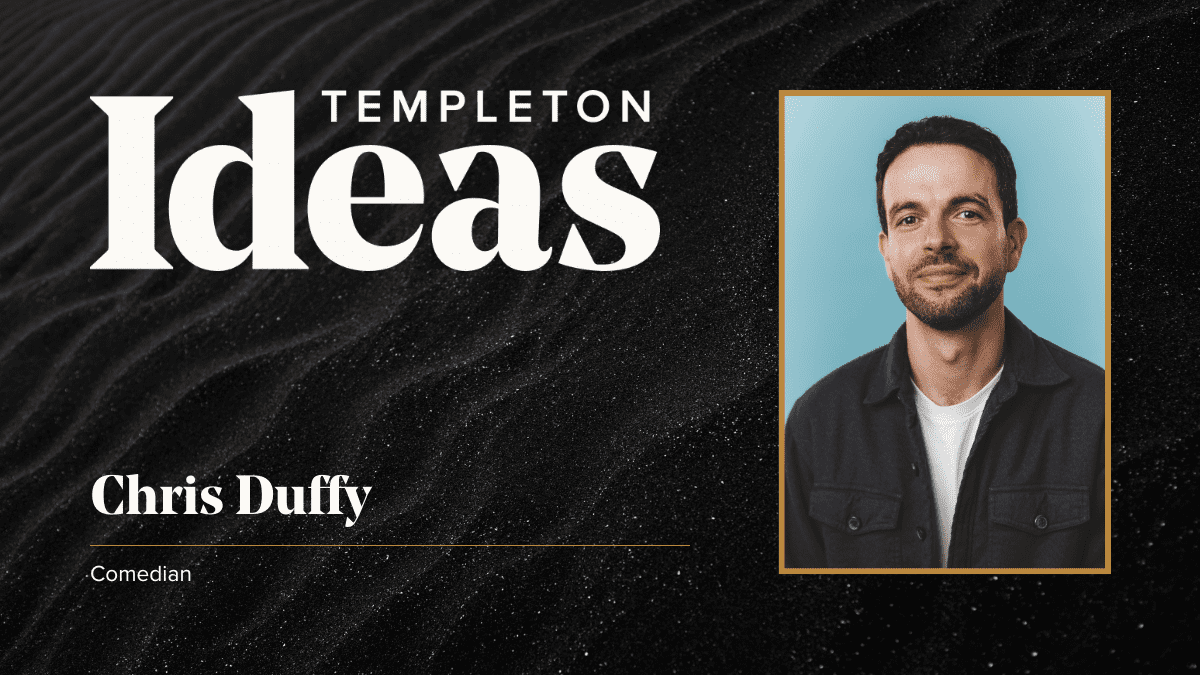
Chris Duffy is an award-winning comedian, writer, and podcast host. He currently hosts the TED program How to Be a Better Human and gave a popular TED talk entitled, “How to Find Laughter Anywhere.” Chris recently expanded his comedic repertoire by publishing a new book called Humor Me: How Laughing More Can Make You Present, Creative, Connected, and Happy. Chris is also a former fifth-grade teacher and a former fifth-grade student.
Humor can be a good way of diffusing the tension around discerning who is right and who is wrong. Instead of furrowing our brows, sometimes it helps to step back and laugh about a situation, especially if we’ve made an error. To find out more, we invite you to watch the video The Joy of Being Wrong.
Transcripts of our episodes are made available as soon as possible. They are not fully edited for grammar or spelling.
Thomas Burnett: Welcome to the show, Chris.
Chris Duffy: Thank you so much for having me. I’m really excited to be here.
Thomas Burnett: I’m always fascinated about people’s childhoods because I feel like so much of what we love as kids finds ways to bubble up in our adult lives.
Do you remember your earliest memories of making people laugh?
Chris Duffy: One of the earliest memories I have is my great uncle Norman was in the hospital with a heart attack and had surgery and he was going to be okay. But I went in the recovery room and I had brought this terrible book of jokes called 101 Shaggy Dog Jokes.
And I was like, I know what makes people feel better is telling them a joke. So I was like telling Norman while he was lying in the hospital bit, how do you make a shaggy dog float? Two scoops of ice cream, some soda, and a very small shaggy dog. And it’s just that’s not funny by any definition.
Thomas Burnett: The question though is how did they land with your uncle?
Chris Duffy: I think the idea that I was there with a book of jokes, trying earnestly to deliver jokes was in itself funny, but the content of my jokes themselves was not funny. So I think it was appreciated as an act, but you got to work on your material.
Thomas Burnett: Yeah.
Chris Duffy: That was one of my first memories of trying to make people laugh, and then I’ve always just felt, and I still feel, like the most fun you can have in the world is being with a friend, laughing so hard that you cry, you can’t breathe, you’re clutching your sides. So from elementary school to now as a middle aged dad, that is what I’m looking for out of a day.
Thomas Burnett: One of the things I appreciated from your book is you said that a key to humor is being observant about the world around you.
In your formative years, where did your interests in observation, curiosity take its initial steps?
Chris Duffy: I think I’ll give you two answers to that. One is I grew up in New York City, so from the time I was in a stroller, I was walking past people speaking every conceivable language. I was walking past people wearing all different types of clothing, living all different types of life.
And so there was just this natural desire to be like, what is that person doing? What are they thinking? What’s going on over there? So I think part of it was that, but then I also think a big part of my interest in, and a curiosity about people is because my parents had this really beautiful loving marriage that is also a very cross-cultural marriage in that my dad is a tall, Midwestern Christian, and my mom is a little East Coast Jew. And in a way that I’ve since learned is unique for interfaith marriages, they both continued to practice and to believe in their individual religion.
In our house, there was always this sense of like different people have different ways of experiencing everything from the small to the extremely large existential questions, and there’s not necessarily like the one right way as much as we can like respect and be curious about each other’s decisions and paths.
Thomas Burnett: I can imagine there’s a lot of joke material that’s built into family dynamics.
Chris Duffy: Of course, there’s not a person in the world who doesn’t have a funny family story. And just for me, there’s no more perfect joke than a Jewish mother naming her son Christopher and not understanding. She literally, until I was like three, didn’t get why is there no one else at the synagogue with a son named Chris?
And then someone was like, it’s Christ over. And she went, oh no. I think you know a lot of professional comedy, but also the time that I’m more interested in. Like the humor between regular people in regular life, a lot of that just comes from relating and understanding the experience that someone else is having.
There’s a reason why so often when we watch something really funny or we see something hilarious, we go, that’s so true. Oh, that’s so true. Or, I’ve been there. That’s a lot of what underlies the humor of everyday life is it being relatable or understandable. And what could be more relatable and understandable than the quirks of a family and the way things are weird and not perfect?
Thomas Burnett: Thinking about youthful ambitions as you imagined going off in the world, where did becoming a fifth grade teacher fit into your big ambitions as a, say, teenager?
Chris Duffy: Being a teacher was very much one of my big ambitions for my fourth grade birthday I asked for reference books and I got like a thesaurus and an abridged dictionary and I just loved that kind of stuff and I still love that so much of my career is built around, like, how can I talk to smart people and ask them questions.
But, I grew up in a family where like my dad worked for the Port Authority. The idea of being a comedian or doing something in entertainment, it was the same kind of thing as like, when I grow up, I’ll be the king! It never occurred to me that you could work in comedy. I thought you could just be funny in your regular life, and I loved teaching.
I loved working with younger kids. So I was very excited to become a fifth grade teacher and I loved being a fifth grade teacher when I was a fifth grade teacher. So much comedy of just seeing the things in the elementary school, and I loved like the way that kids experience the world and come to you with really deep questions about things that you’ve never thought of before.
I thought that was so fun, but it was also really hard. All the problems of the world are in kids’ lives. They don’t just go away.
Thomas Burnett: Tell me about the funniest person you’ve ever met.
Chris Duffy: There’s a one definitive answer here. One of my fifth grade students, this kid, Gary, was, and is, the funniest person I’ve ever met in my entire life.
He wasn’t always the best behaved student, in fact, in many ways, he might’ve been the worst behaved student in many times. But he was so funny and sharp and very honest, and at one point, he and I started working together to try and get him writing more, and he developed this idea that he would be the food critic in the school newspaper. And he would review cafeteria food and his reviews of cafeteria food at this school are, to this day, some of the funniest writing that I’ve ever read in my entire life.
Like it’s such perfect comedy that you can just hand his reviews to someone and they will burst out laughing. I’ve literally performed them on stage all around the country, just reading them verbatim and it always crushes. It’s so funny because he captured some of the language of food reviews, but it’s applied to a vegetarian hotdog and baked beans that served in a tray at the elementary school.
Yeah. So Gary, all time greatest comedian.
Thomas Burnett: Have you kept up with him at all over the years touch base and said you’ve made your living recycling his incredible creative humor?
Chris Duffy: 100%, yes. I am still in contact with him. In fact, we even collaborated, I was telling a story that involved his food reviews.
I got to bring him and his mom out to Chicago and on stage after I performed in this room with a thousand people, I got to say, and Gary’s here and Gary stood up and got a standing ovation from the crowd. But yeah I’ve stayed in touch with him. He is now a full adult with a job who is not a child in any way anymore.
Thomas Burnett: I want to ask you about professional comedy. It feels to me as an outside, like a very tenuous existence. Do you and some of your colleagues have anxiety that you’re going to wake up one morning and just not be funny or at the very least, no one laughs at you.
Chris Duffy: That is so interesting, Tom, that is what you thought of as the tenuous part of comedy.
I just think at first, bombing is something that people are very interested in, right? Like the experience of you get on stage, you think it’s going to go well, it goes badly. It’s so embarrassing and it’s a public obvious failure, and so people really have an interest in that. And yet, at first it was horrible.
It was so unbearably bad. And then what you realize the more that you perform is that people don’t remember that. You might remember it, but like I’ve seen so many bad performances and I couldn’t tell you a single one of those people’s names. I can only tell you the names of people who I loved. That’s what sticks.
So that’s one part that gets easier. And then the other part is. The more that I’ve done comedy, the more that I realize that if you’re only doing well all the time, it just means that you are only using the safe tried and true jokes. You’re not trying anything new. And if you want to get better, you have to try new things.
And the new things, of course, are going to need to be polished. So I think for me now, like when an audience doesn’t respond, it doesn’t tell me something about me. It tells me something about my material. Oh, that wasn’t resonating, or, I need to clarify that, or I started in the wrong order, or the room was not right.
The thing that it feels really tenuous though, is the financial piece. Is this job going to keep being a job? I think every comedian I know feels like one more year and then, back to temp work or who knows.
Thomas Burnett: When I think too, another, just as an outsider, I think of comedians on a stage by themselves with lights on ’em, and there’s this audience, hopefully there’s some dynamics and they’re receptive and they get your jokes.
Very much a kind of a solo act. And then I think too about your role as you’re the host of How to Be a Better Human Podcast, and there you’re engaged in interviews. How do dynamics change when it’s you in conversation with someone versus performing directly to an audience by yourself?
Chris Duffy: How to Be a Better Human, we’re about to go into our sixth year and so it’s been this longstanding now pillar of my life and career and it was really surprising when I got it because how to be a better human is not edited for laughs. Many episodes are so far from being funny at all, but the reason they wanted me to host it is because Ted wanted someone who could bring a lightness and cut through some like self seriousness.
That can sometimes happen when you’re talking to really smart people. I think the way that humor and comedy plays into that is. I’m okay with being laughed at I’m fine with being a buffoon or a clown. I want you to laugh at me. And so that lets me ask maybe the like more basic or embarrassing questions that other people might have to pretend that they know the answers to.
If I’m interviewing a physicist, I can go, what is physics? I do not know. And I think that for many people it’s disarming and I think that leads to really good conversations. And I also think, to answer the other part of your question more broadly in my life. I think the skills that make you able to be like the one person on stage in a spotlight with a microphone are often skills that are like, look at me. You shut up. It’s my turn. I make you laugh. I am the show.
And I really try hard in my own life to cultivate the other part of humor, which is the like we are having fun together, we are laughing, we are deeply connected. We are acknowledging the absurdity. We are not taking ourselves too seriously.
And I think those are good people skills because that’s me trying to laugh at your joke, Tom, just as much as trying to make you laugh at my joke and just trying to spend as much time laughing together. So I think that also really comes into play in my work when I’m interviewing a serious person to say I want to listen to you, I want to pay close attention, and I want to call out the things that are interesting or unusual.
Thomas Burnett: Another role you’ve taken up is writing a new book.
Chris Duffy: That’s right.
Thomas Burnett: And what struck me already in the introduction was that you said something like, the world needs more humor. It does not need more comedians. Can you tell me a little bit more what you mean by that?
Chris Duffy: If you’re great at comedy, great. Keep doing it.
I’m not trying to tell you to stop, but I think the world is so full of value and reward for building an audience and for having a brand and for being a person who it’s all about you. And I don’t think we really need more of that. But what I think we really need more of is people who are willing to laugh at themselves, to not look perfect, to not look coherent and logical.
For people who are willing to be like, I’m a mess and it’s okay for you to see that, and I welcome you into my mess. And we can laugh about it together. And also for people who are willing to see absurdity and nonsense and call it out and not pretend like it just makes sense. I think that’s the kind of stuff that we desperately need in the world.
Thomas Burnett: In terms of needing more humor, is that something that we win the lottery and we’re born to have a good sense of humor and others like struggle with it? Or is that something that we can cultivate?
Chris Duffy: I’ve seen so many people learn how to be funnier and how to have more laughter in their life. One of the fun parts of having been in the professional comedy world for years is that I saw, when I started, a lot of people who are really not very good and then became incredible and now are hugely successful.
But I also think aside from the performing part, you can just get better at noticing things. You can get better at laughing in your everyday life, not having to tell anyone about it. But just it’s easy to fall into this trap of walking through the world and it’s all serious and it’s all a to-do list and there’s nothing light.
And I think you can easily build that muscle by just looking around and seeing the things that you’re missing. What is one thing that it seems a little out of place if you just take a little bit of a step backwards and look at yourself and try and search for the humor in yourself and in the world, you start finding humor everywhere and it makes your life so much better. Can I turn this around and put it on you?
Thomas Burnett: Oh, please.
Chris Duffy: What role does humor and laughter play in your life right now? How big of a role does it play?
Thomas Burnett: The funniest parts of my life are my memories. I was thinking about the inside jokes I had with my grad school roommates.
Anytime we get together, even in a text message, somebody just drops in a name like Marvin, and I know I’m going to get a chuckle out of that. Oh, that’s so great. It’s interesting because for me, graduate school is one of the hardest periods of my entire life, and yet the feelings that I can still evoke were the funny moments that I had with my roommates and with some of my friends.
And I don’t know, maybe that’s a coincidence, like hardest period.
Chris Duffy: I don’t think it’s coincidence at all. Part of what makes things funny is the tension is high, and so the release is so satisfying. And I also think when we’re in these intense emotional moments where we’re stressed, humor is so much more important to us too because it’s just oh, I needed that so badly.
And laughter does that. It clears the cobwebs away and it’s really satisfying when you’re in those deep, dusty, cobweb ridden moments in your life. Poof, the wind comes and blows it all out of humor.
Thomas Burnett: Yeah. So let me fast forward to the present. I’m a parent of three young children. I’m tired all the time. I don’t get enough sleep. How do you also, as a parent of young children, how do you keep your sense of humor?
Chris Duffy: I think I want to, first of all, just be honest with you, which is that I wrote this book, I started writing it before my first kid was born, and I finished editing it as my second kid was being born, and now it is coming out and I have a 2-year-old and a four month old.
It’s been funny to talk about this book with people because they’re like, and you must be so funny and laughing all the time. And I’m like, I wrote a book that I need, oh, I don’t take the advice. I woke up and nothing’s funny. I haven’t slept and oh, I’ve been cleaning vomit off of the sofa and it’s 3:00 AM last night. And I knew I was going to have to do this interview and I wanted to be sharp and talked to Tom and look good. And instead I was in the bedroom lying on the floor for three hours just with my arm wedged through a crib so I could hold his hand.
And so like I will say that I don’t follow my own advice all that often right now, but when I do, I’m reminded of why I thought this mattered in the first place.
So let me just give you one example of a practice. I talk in the book about how my wife and I try really hard at the end of every day to sit together or lay together and find one thing that we can laugh at together to just like connect with a brief moment of laughter. Now, when I wrote that, it was true that we were doing that every night.
We have not done that every night for a while, now. Recently we just said we need to like just lay on the couch and show me a silly, funny video, or show me a silly funny meme or something that’s going to make us both laugh. And we did it. And I was like, oh yeah, there’s a reason we used to do this every night and.
It’s 30 seconds, and we both felt so much more connected and we felt like the weight of the day and of caretaking and exhaustion went away. And not forever, it’s not like it didn’t come back, but there was a brief break from that as I showed my wife literally a video of a man trying to jump across the river and falling in and getting soaked.
There’s nothing really profound about what the video was or about the idea, but I think the underlying piece of this is an opportunity for connection, and it’s an opportunity where, like you said, when you’re in grad school and it was stressful, then the laughs mean more. Let me just say one other thing about kids in particular, which is:
I think that parenting for me is such a great example of how humor can turn something on a dime and it can just transform a situation immediately because like I will be so locked into what has to happen and to being like, we’re behind schedule. You’re not buckled into your car seat. It will not be funny.
It’ll seem very serious. And then the kid will unintentionally do something that is hilarious and all of a sudden you’ll go, I see it from a completely new light, and all of a sudden I’m the ridiculous one.
Thomas Burnett: I want to turn to maybe the dark side, a bad humor. And you mentioned in your book, and I found this to be so true, is that bullies often have a really remarkable sense of humor in that they can be very creative in how they can get under someone’s skin. Really hurt people. How do we distinguish between good humor and bad humor and known when we might cross the line.
Chris Duffy: If you just think about the like cartoon image of a bully, right? It’s like a bunch of people standing in a circle pointing and laughing at someone. It’s not like laughter is always good, as you pointed out. I think there’s a couple of ways that you should like test for whether your humor is the good kind of humor or the bad kind.
And one is just like, how does it make the other person feel and how does it make you feel afterwards? Do you have like a sick to your stomach feeling? Does the other person go home and be like. Wait, is that what people think of me?
Because humor has this amazing ability sometimes of bringing us closer together and me being like, oh, Tom, this was so fun. I can’t wait to hang out with you again. That’s the good kind. And then other times being like, wow, like Tom’s funny, but like why is he saying that?
A test that sometimes comedians talk about, is this like punching up and punching down? Is the joke towards someone who has more power, more social capital than you? And if so, it’s probably okay. Like it’s fine if I make fun of the King of England because. You know what? He’s the king. And it’s not as fun if I make fun of the person who is sleeping in a tent on the sidewalk outside of the school. So I think that’s one way that you can think about it.
And then, I think where it gets really gray is a lot of times people make self-deprecating jokes and you can bully yourself. If I make a joke about how I’m bad at sports, that’s not a problem. Because I’m fine with not being good at sports. But if I make a joke about something I am more self-conscious about and I’m just trying to make it before you make it. Maybe that’s actually like not being so kind to myself. So I think there’s a lot of considerations that you should think about when you’re making jokes without getting too in your head, just like these are things to think about afterwards and redirect in the future.
Thomas Burnett: I’m going to ask about humor, not at the individual level, but within maybe larger groups, organizations, institution, businesses. I’ve heard comedians will often get hired to tell jokes at some corporate event. Have you looked at the nature of humor at that kind of higher level of groups.
Chris Duffy: I’ve done a lot of those events and it’s always really interesting and I think the reason why laughter is so fun, like why it’s like great to go and have a keynote speech that is hilarious is because it can bond us together and create like a group identity. You and your grad school friends, you have this shared thing where if you say Marvin, everyone knows what it means and it makes you laugh.
And that’s not just fun because it’s like a way to laugh. It’s also fun because it’s building a culture and an identity. This is part of our lingo, this is part of what makes us work and it makes you more cohesive. It makes you care more about each other. It makes it easier when there’s the inevitable frictions and disagreements to be like, okay, but we’ve built up all this relationship capital that’s in the bank and we can spend a little bit on it too.
So there’s some big picture reasons. I talk in the book about how Abraham Lincoln, people don’t think of him like this now, but at the time he was regarded as a hilarious president. Like really funny, full of jokes. And that was one of his real talents as a leader, especially when he was bringing together this cabinet of rivals of people who did not like each other, was he would make jokes, he would get everyone laughing, and then he would get the best of these people who would otherwise not want to be together.
Thomas Burnett: Yeah. Using humor to achieve things with other people that they would no way to agree to in a sort of sober, serious situation.
Chris Duffy: Also, can I just say a little bit of a meta thing here, which is. For How to Be a Better Human, we got this grant from the Templeton Foundation, and I got this big list from you all of what are Templeton virtues?
And it’s been really interesting to see how I think humor really plays into so many of the virtues that I care about and that I cherish. How can you build connections with other people? How can you have, like care for community? How can you have resilience? How can you have awe? How can you have wonder, curiosity, kindness, humility.
I think so many of these are things that I have been surprised to see that humor really touches on a lot of them in an interesting way.
Thomas Burnett: We often think of virtue development, character development as being so serious and that somebody who’s particularly good at it, who say, who’s achieved some of Templeton’s mission to cultivate and hold virtue in high regard, that sometimes can come across as those people are so sanctimonious, the stereotype, a good person, is serious and not fun. And then the person who’s always cutting up is like the bad kid in class, right? It’s the class clown, the person who’s undercutting the teacher and somehow destructive of these high-minded aspirations. But you flip it on its head.
Chris Duffy: Yeah. Buddhists sometimes talk about like this cosmic giggle.
As one of the highest forms of enlightenment that you can get to is to like, see the giggle and the ridiculousness and everything. And I’ll just put a plugin for a book that is not mine, that I think is like truly hilarious book and also incredibly insightful, is called Between Heaven and Mirth by Father James Martin.
And it’s about the role of laughter, humor, and comedy in religion, specifically in Christianity, Judaism, and Islam. And that book is so funny. Just opened my eyes to all of the like spiritual parts of laughter and joy. And I think people who are actually smart, like really smart people, not people who seem smart but maybe are pretending those people are always willing to admit all the things that they don’t know.
And one really big sign to me that someone is like genius or enlightened, is that they don’t take themselves that seriously.
Thomas Burnett: As people seek out more humor in life and opportunities to laugh, you mentioned that one of the components with humor is an ability to take social risk because you don’t know if a joke is going to land or if you say something that might get laughed at rather than generate levity. Do you have any advice for someone who’s just really terrified about social risk and just feels the weight of potential failure or the wrong kind of laughter, should they open themselves up and put themselves out there in the world?
Chris Duffy: If you’re one of those people, first of all, I really hear you and feel you, and it’s not just in your head. It is scary. We are so programmed to feel scared about talking to a stranger or making yourself vulnerable in this way, and yet my advice to you is the most basic advice, but that is truly like very rigorously research backed, which is that people dramatically overestimate how bad and scary it’ll be to talk to a stranger to, for example, say hi to a stranger on the bus. And they dramatically underestimate how much better it will make their day and the stranger’s day.
And then I’ll also say, think about the upside, which is that like you can laugh on your own. You can laugh and have a good time, but humor, laughter, comedy, the magic of it is the social piece, is the way that you and another person get locked into this moment that you are connected and they’re having so much fun together. And so I do think this is one where the risk is really worth the reward. Or wait, is that right? No. The reward is worth the risk!
The more that you try it, the more that you’ll build the muscle, right? That my whole philosophy, the whole reason I wrote this book, is because I think that it is not a thing where you have to do a dramatic thing or you have to be a person who is this kind of person. I think if you do small, repeated actions, just like building a muscle, you will build that muscle and you will have more laughter in your life.
So take a risk, a small one.
Thomas Burnett: I think maybe another way to think about too is to do something way beyond normal, hard. In my case, I’ve learned two foreign languages through incredible amounts of pain, but I deeply wanted to get there. And so one of the absolutely hardest things is not just to communicate or exchange information, but to have a conversation that’s enjoyable and pleasant and elevates your mood.
The command of a language that you need in order to do that is actually extremely high. And so I found that by just wearing myself out for like years to get to that level in Spanish and German. That when I found myself speaking English, it was just so easy to have a conversation that’s just like effortless.
And so that’s so funny. I switched from being a introverted, shy, native English speaker to like I’ll talk to anybody.
Chris Duffy: That is really funny and I love that when I say to people, I don’t think we need more comedians. I do think we need more people with a better sense of humor. This is exactly what I mean, right?
Because the mindset of comedy. The mindset of humor is, it’s okay if people laugh at me. It’s okay if I look ridiculous. It’s okay if I say something wrong, it will connect me to them. And the comedian version is it will connect me to the audience. If I share something that is embarrassing, it will connect me to them.
Now, in regular life, the way this plays out is if you want to get better at Spanish, it is unavoidable if you don’t already speak Spanish, that you will make mistakes, and yet you must speak to someone who is a native speaker and make mistakes and sound bad in order to get better. If you view that as not a shameful, oh, humiliating moment, instead like a delightful, hilarious learning moment in a new language, it changes your ability to put yourself out there.
And anyone who is fluent in another language will tell you that they did it by speaking to people. They did not do it alone in the room practicing until they could go out and flawlessly communicate without making any mistakes. And that’s the whole thing. That’s the whole version of all of it in life is be okay with being a little bit of a buffoon and being a little embarrassing and realizing that will be a positive thing rather than a thing to be avoided.
Thomas Burnett: And the German language people are still laughing at statement that John F. Kennedy made in the 1960s and he told people in Berlin “ich bin ein berliner”, which literally means in German, I’m a jelly donut.
Chris Duffy: We so often think the ideal would be if we were perfect, if only I could be flawless and impressive, then people would like me the most.
There’s this study where they did with job applicants and they had research assistants pretend to apply for this job, and then they had the people evaluate them and they had a person go in who was like flawless, perfect resume. Did the interview perfectly. That person, of course, scored really highly.
Who scored more highly than them? The person who had all those qualifications and had just spilled coffee on their shirt and went, oh my God, I’m so sorry, I just poured coffee all over myself! People like that person more. They think they’re more qualified. They want to be with that person because nobody wants a totally perfect person.
You want someone who’s a little bit of a mess. You still got to be competent and capable. But, we delude ourselves into thinking that we shouldn’t have the spilled coffee on our shirt, and in fact, the person who admits that they just poured a drink on themselves and is still coming in, that’s the person we like the most.
Thomas Burnett: I’ve got two questions I want to wrap up with. Can you tell me the story of why you don’t have a LinkedIn profile?
Chris Duffy: Ah ha! So as a comedian, I had never really understood the purpose of LinkedIn. Friends who have regular jobs had told me that they do it. So at one point I was just trying to experiment to see what LinkedIn was like, and I went on and I was immediately amazed that when you make a LinkedIn profile, they don’t verify your job.
You could just say I work at Nike. I work at the Templeton Foundation. And they would just take you at your word, like I would’ve assumed that your boss has to click. Yeah, they do work here. And so because of that, I was just curious and I was like, I wonder how high up I can go. And so just to test it, I made myself the CEO of LinkedIn and I clicked save.
That made me laugh really hard, and then it made me laugh even harder because LinkedIn sent an automatic email to all of my contacts to everyone in my address book saying, congratulate Chris on his new position, CEO of LinkedIn. And they sent that email that came from like LinkedIn. So obviously that was hilarious and it was probably the greatest joke I’ve ever made, and it wasn’t even intentional and then it stayed that way for literally more than a year.
Finally, when it started going viral after the year when it said congratulate Chris on one year as CEO of LinkedIn, I had an exchange with a woman who works at LinkedIn called Faith on the Trust and Security Team. And Faith said we’ve frozen your account because we’re concerned about accuracy.
So I sent Faith a photo of my license front and back and said, yeah, my name is really Christoph, that’s really me. And she said, no, the problem is not your name. The problem is that you’re saying you’re the CEO of LinkedIn. And so I responded to Faith. Faith, you’re taking a pretty disrespectful tone for someone who works for me. And two seconds later, she deleted my account permanently. So I’ve lost my ability to be on LinkedIn, although I have made like a burner LinkedIn account now where I am the owner of Linc, LINC, apostrophe D, INN, which is a business focused bed and breakfast.
Thomas Burnett: All right. Last question I want to ask. I’m grateful that you took this time with me today.
If you could travel back in time and meet your childhood version of yourself, and you wanted to make him really laugh, do you have something in mind that you could tell him?
Chris Duffy: Tom, I got to be honest. You talk to a lot of distinguished, sophisticated people who, have a thing called dignity and I don’t have that and I’ve never had that.
So I would probably just make a fart noise and or moon him. And I think that those are the most surefire way to make him laugh. I think if I told him like, Hey, one time you poop your pants, he’d be like, that’s good stuff. I like this guy!
Thomas Burnett: You’d have a great time with my kids. Can I have you over as like a babysitter sometime?
Chris Duffy: I could do toilet humor for hours on end. I really could.
Thomas Burnett: All right. Good luck. Continued success with your show, with the book, and let’s touch base again soon.
Chris Duffy: Thank you. I’d love that.
