


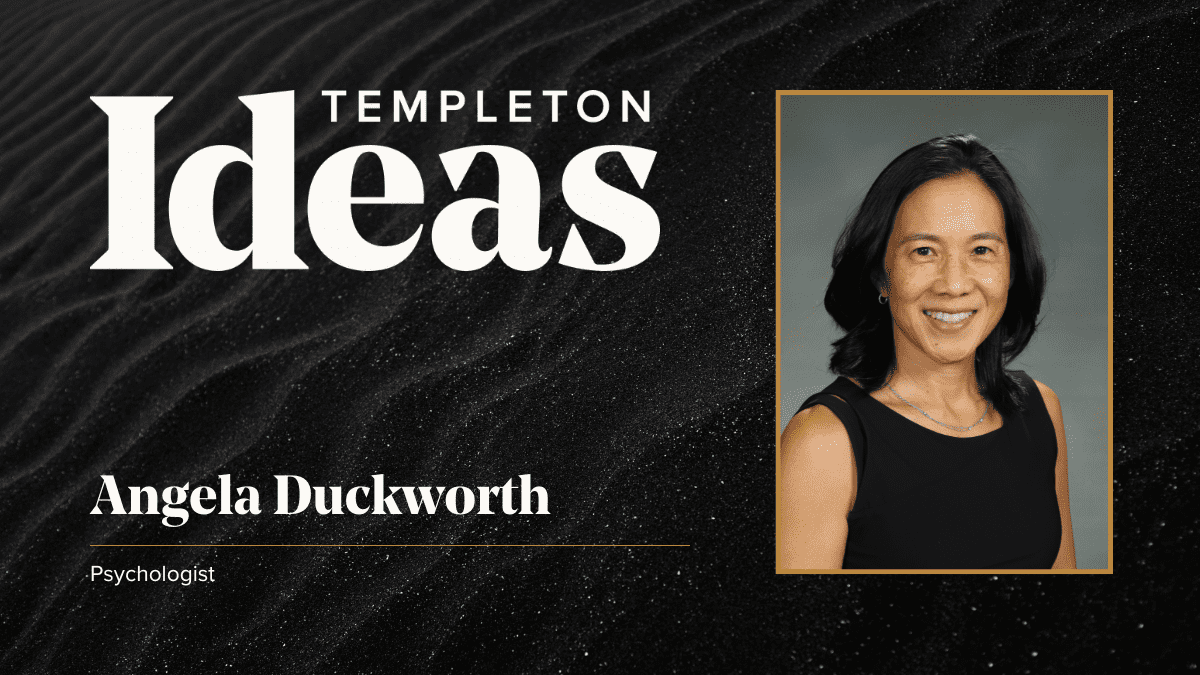
Angela Duckworth is a professor of psychology at the University of Pennsylvania, where she studies human character traits that lead to high achievement. She authored the bestselling book Grit: The Power of Passion and Perseverance, and her related TED Talk has been viewed over 37 million times. In 2013, Angela received the coveted MacArthur Genius Award. She is also the co-founder of Character Lab, an organization that advanced scientific insights to help children thrive for over a decade. Angela joins the podcast to discuss forming character through the heart, mind, and will.
Grit is a virtue that helps us get things done and reach high achievements. But of the many different things that we could tenaciously pursue, what should we prioritize, and how do our individual goals fit into a bigger picture? To find out more, check out our Templeton Ideas essay, Hope and Grit: Companions on the Road to Change by journalist Annelise Jolley.
Transcripts of our episodes are made available as soon as possible. They are not fully edited for grammar or spelling.
Thomas Burnett: Angela, welcome to the show.
Angela Duckworth: Thank you, Tom. I’m excited for this conversation.
Thomas Burnett: For the people that know you, they know you as a scholar, as a TED speaker, as someone who’s really dedicated her life to helping kids thrive. And I want to get into that. But I want to ask actually about your own childhood.
First, when you were really young, what made you tick and what were you passionate about?
Angela Duckworth: I recently asked my mom, who’s now 90 years old, what I was like as a little girl, and without taking a breath, my mom said “intense”. And that was not a word that I thought she was going to say, but I think my mom and I would agree that my father, who’s now passed, was himself single-mindedly focused on achievement.
And I think it was a pretty clear message for the kids that being excellent at what you do was the most important thing. I remember once I was walking with my dad hand in hand, I think I was doing a high school essay on the meaning of life and I shared with my dad my hypothesis, I must have been like 16 or something.
I was like, I think the meaning of life must be happiness. And my dad stopped in his tracks, literally, and he said, the meaning of life is success. I think any person I grew up with lots of things that I was trying to do, but in this conversation I know we’ll be getting to character. I do think that as a little girl, I had the sense that achievement was a lot of life, but especially as I grew up, I think I realized it was certainly not the only thing and not the most important thing.
Thomas Burnett: Were there any adults or people in your life that did some mentoring for you, either formally or informally, and had some life experience wisdom that they were able to impart, that you internalized deeply and gave you some guidance?
Angela Duckworth: I think outside of my family, there were two teachers that I had that made an indelible impression.
One was Dr. Roland. She was my French teacher, and she wore scarves and high heels and was so glamorous. And she had us read, of course, in French, Voltaire. And when we read Candide, I mean, we really read it like you were like trying to understand what Voltaire wanted to say. So Dr. Roland was a formative influence.
And then I had this teacher, Mr. Carr, and he was my English teacher. When I sat in Mr. Carr’s classroom, he was so intellectually curious. He would come in and be very excited about something he had read that weekend or a play that he was in, and you just couldn’t not be intellectually curious just from being around him.
And what’s funny is that when he retired from the Cherry Hill Public Schools, after a very long and distinguished career as the world’s best English teacher, in my view, I reached out to the kids whose names I remembered from my class. And one was running a bookstore, another one was working. As a physician.
Every single one said that Mr. Carr was the best teacher they ever had. Every single one of us said “Oh my gosh”. I was just like, such an idiot until Mr. Carr showed me love of language, love of ideas, love of words. But anyway I think that the question you’re asking is a great one because who are we, if not the product of these loving influences throughout our life?
Thomas Burnett: One thing people may not know about you is that before you became a professor and focused on research, you taught middle school math for a while. Can you tell me about why you chose that role and a little bit of what the experience was like?
Angela Duckworth: I had spent a lot of time working with kids when I was in college as a tutor and as a big sister and running an afterschool enrichment program, that sort of thing.
When I decided to become a math teacher, it was partly because of that, I’ll say math in particular, so many kids feel like they’re either smart and they get math or they’re not math kids and they’re not smart enough and they don’t get math. And I think probably had some kind of intuition that as a math teacher, I could show kids that they could learn it.
So I became a math teacher, first in the New York City public schools teaching seventh grade math. Then my husband and I moved to San Francisco. I taught in the San Francisco Public Schools for several years, so I moved from middle school to high school. And yeah, I think that experience certainly shaped everything else that would come next.
I think I came to my number one insight as the thing that would orient me, which is that young people are amazing and that they are so much more than their IQ scores or their marks on very narrow measures of achievement. And yeah, that set me off to do, among other things, my current work, which is to be a psychologist who studies young people.
Thomas Burnett: What led you to make that pivot from being in the classroom as a teacher to studying research that would have impact and influence on classroom teaching?
Angela Duckworth: When I decided to become a psychologist, I think it was because I took stock of what really I considered to be my interest and my strengths, and I realized that I had an enduring interest in human motivation, which is probably why I was a neurobiology major in the first place.
So I kind of figured out I love kids, but I don’t want to be an educator. I am really interested in human nature and I have an analytical scientific lean that led me to become a psychologist who studies character and human motivation so that maybe in that small way I could help kids become their best.
Thomas Burnett: Of the many things you’ve done, you are a co-founder of an organization called Character Lab, which harnesses scientific insights with a goal of helping kids thrive. I want to focus on that word “character”. What does it mean and what’s important about it?
Angela Duckworth: I would be remiss if I didn’t also acknowledge that the Templeton Foundation was a key funder and even cheerleader for the entire decade that Character Lab existed.
And I would also be remiss if I said that I founded it myself. So there were two educators, Dominic Randolph and Dave Levin who. Essentially knocked on the door of my advisor. My PhD advisor was Marty Seligman, and they said, we want to work on character. And what emerged in that conversation was their perspective as educators that young people are developing along with their math skills and their literacy, they’re developing character, they’re developing the ability and inclination to be kind, to be honest, to have zest, to have curiosity, to be creative, of course, to get things done. So to be gritty, if you will, to self controlled, proactive.
So anyway, character Lab tried to make that research easier for scholars to get more scholars into character development research and then to share the findings of that research with parents and educators. And I think that mission is an evergreen mission. I think it’s a good one. I’m proud of what those scholars were able to do.
Thomas Burnett: So there is some qualitative sense of what character is, but. I know that scholars love to drill down and be precise. How do you get more granular about what character traits are and maybe how they clump together?
Angela Duckworth: So I have found it useful to talk about strengths of heart, mind, and will. So a tripartite classification, I will tell you what those mean to me, but I’ll also say that I think the scholar who’s done the most work on this question empirically is Bob McGrath and he also finds these three dimensions to be a useful way of cutting character at the joints.
So I’ll take them in order. So strengths of heart I think are what leap to mind as character. There are lots of research studies on if I meet a new person for the first time, Tom, right? In our first conversation, what leaps out often is how much integrity you have, how straightforward you are, how trustworthy you are, how empathic you are.
So strengths of heart are all about the things that you do that are good or bad for other people’s wellbeing. I don’t study those much as a scholar, but when I am asked, as a mother, for example, which dimension of character’s most important, if you had to give up one. Probably the most important one, and the one I would not give up is the category of strengths of heart.
I would also, by the way, include in this like social intelligence and emotional intelligence. I mean anything about you and other people. Strengths of mind are really the intellectual aspects of character, which again, Templeton Foundation has very generously supported. I think they are to be credited for advancing much of the work on curiosity, on open-mindedness, intellectual humility, creativity. That’s why their strengths of mind, they’re up here, maybe not down here in terms of like our head versus our heart, but those are, I think, interesting in their own right.
Economists have lately found, I’m thinking about David Demming at Harvard in particular, have found that thinking critically, thinking openly, thinking creatively, thinking humbly. These are very important as the economy shifts towards AI. And I would venture to say just on my own behalf, I shouldn’t speak for any other scholars, but more and more it’s important to have strengths of mind.
Some would say ” Oh can’t we just let the computer do our thinking for us?” And I would say exactly the opposite. It’s now’s the time to make sure that our kids are thinking. And then finally, there’s what I do study as a researcher, which is strengths of will. These are the get it done strengths, impulse control, self-control, productivity, a grit, growth mindset.
I think these are all about getting better, performing well. And I think achievement is one thing that character gets you, but not the most important thing, but I would say as a mother and as an educator, do I care whether young people learn how to get things done? I do. I don’t have two daughters who are loving and honest and kind and curious, but never get anything done because the world needs a lot to get done.
Thomas Burnett: All right, heart, mind will, once we’re aware of some of these character traits and what categories have fallen. The next question I want to ask is then how do we strengthen them?
Angela Duckworth: When we designed the playbook for each of the strengths in these three categories, we said, okay, let’s make a short, scientifically valid definition.
Let’s write just a little bit about what this looks like so there’s like a little pulse check for each one. Like how would you know that you’re being kind, answer these six questions. And then we would organize tips and we would send out one of these tips every week, so we call it the tip of the week.
And one week it might be a strength of heart like honesty. Another week it might be a strength of mine, like curiosity. Another week you might get a strength of will like grit. And they would all be written by. Individual scientists who are experts in that topic, and usually with a don’t and a do.
So that was our means. But I also want to tell you, Tom, that when we put together this like overall landing page playbook for each of the strengths, I said to myself as a psychologist, what do I know about how characters developed across the board? And so for each of the strengths we have, enable it, model it, and celebrate it.
So what do number one out of these three, and I think sometime that gets overlooked. Enable, it means put your kids in situations that make it easy for them to demonstrate this strength. I’ll just use self-control as an example. So self-control. That’s the ability to make farsighted choices when a shortsighted choice is more luring.
That is self-control. What is the opposite impulsivity that is making the nearsighted choice instead of the farsighted choice when these options conflict? What do I mean by enable it? Part of what a lot of good parenting is, I think is putting your kids in situations where making the farsighted choice is the easy, obvious choice.
So for example, when you send your kid to a school that has a phones free policy, then it makes it easier for your child to at least during school hours, not be on their phone. What about where your child puts their phone at night? I recently had a group of high school students come visit me from Washington, DC and I asked them by raise of hands if they kept their phone in their bedroom and every hand went up but one. And I said to the one student, you’re right. And then I looked around, hopefully with kindness at the other students, and I said, you are wrong. You should not keep your phone in your bedroom. But before I tell you why, raise your hand if you feel like you spent too much time on your phone.
Every hand went up and I said, if you feel like you spend too much time on your phone, then putting it on your nightstand makes it very hard for you to do what you just said you didn’t want to do. So that’s what I mean by enable it, like putting your young person in a situation physically and socially, that makes it easier for them to exhibit that character strength.
Model it is just if you don’t want your kids to be on their phone all the time, look in the mirror, are you on their phone all the time? Because children will emulate what you do. And the last thing is to celebrate it. We do that at a very local level when we praise our children for being kind or honest or for staying focused through a whole afternoon of studying.
So we should praise and celebrate and reward those things at the local level. And I also believe as a society that when we ask ourselves who are our celebrities? Who gets the headline? We might also ask, are we honoring character if we’re not celebrating it? If we’re not modeling it and we’re not enabling it, then we’re not going to get it.
Thomas Burnett: Looking at Character Lab, that there’s a lot of different character traits, a lot of playbooks that we could use. How’s a person to go about deciding which traits to prioritize and put their energies into?
Angela Duckworth: I tell CEOs because they sometimes visit characterlab.org and the word parent means the same thing as the word leader. It, etymologically, it means to bring forth. So your job is to bring forth the best in others. So I say to them, I think of this as an away a three part checklist. You cannot have a great company if it does not enable character strengths of heart, character strengths of mind, character strengths of will.
So I ask them to look at their mission statements, their core values, and the posters that are in the break room. And I say, if you are missing a category, right? We’ve got strengths of mind and heart, but not strengths of will. We’ve got strengths of will, they usually have that one because they may have to get things done.
They’re like, we have will and mind, but we don’t have hard, then you’re missing something. So that’s one way to navigate and say, what am I missing? I think when it comes to which of these strengths speak to you, and by the way, Tom, they’re all correlated in these families. It’s rare to find somebody who is very high in honesty, for example, who doesn’t also have social intelligence.
So within a family, these reflect something underlying there. But I would say that it sometimes becomes what is just resonant with you and your tradition. So as a parent you could say, you know what I, I care about heart, mind, and will let me just glance at these options, and you see which of these makes sense for our family to be talking about a dinner tonight, right?
Knowing that when you pull on one thread, you get the rest of the tapestry.
Thomas Burnett: I’m going to turn next to things that we aspire to. So we definitely know our society celebrates winners. People who win championships, people who get into elite schools, get prestigious jobs. Tell me a little bit about either the tension or the compatibility between achievement based priorities and character priorities.
Angela Duckworth: Probably the most visible thinker on this is David Brooks, whose perspective I really appreciate. He’s not an academic, but he’s certainly an intellectual. And when he spoke, I think very personally about his own journey as a human being. He said so much of his life had been working on his resume.
What about his eulogy? And I think that one of the reasons why that’s a very useful distinction is because we tend to celebrate and to quantify and to focus on resumes and achievements. For example, college admissions. Like how do you admit the young person who’s truly kind what’s score do we look for?
Where is it weighed on the scales, right? We have GPA. We have standardized test scores, we have extracurricular involvement. If as a mother I care more about honesty and kindness in my daughters than I do about their resume achievements, what do I do? Because there is this imbalance and. I don’t have all the answers, Tom.
In fact, I have very few solutions that I could propose. But I think just acknowledging first that we have a mismatch between what’s really important and what we’re quantifying and rewarding is I think at least a step toward dealing with this better.
I don’t know that the answer is a standardized test of kindness. I’m pretty sure it’s not. But I will say this, there has been in the last few decades, a real decline in the trust and faith and affection for institutions. Across the board, government of course, but also just other institutions that have always been the pillars of society. I do worry that the decline in our trust of institutions may have something to do with this increasingly lopsided valorization of individual achievements over what’s really important.
Thomas Burnett: What kind of trade-offs are there in terms of where we put our attention, resources and priorities? There’s a group of top tier achievers that have certain needs and opportunities, the middle 50%, so the general population, and then maybe a third category of underserved populations that don’t have the opportunities, or maybe having negative things that are dragging them down.
Where are the trade-offs in terms of who gets the help and how much?
Angela Duckworth: I will first of all tell you that the empirical data suggests that there’s a huge disparity in who’s getting what, right? I think about my own daughters, when they were young, my husband and I decided that everybody in our family would have to do an activity that was hard, that would require real deliberate practice and feedback, and it’d be a way for them to improve. One year my daughter chose the viola, another did ballet for a while, then they cycled through to other activities. All of those cost money, all of those required transportation.
And so the reality is that the kids that you described as the least advantaged or even the middle group, that’s not the case. So just I want to say as a social scientist, Bob Putnam has documented this in his book Our Kids, like the disparity in opportunity to develop character through things like ballet, through music, through football, through softball, it’s hugely imbalanced.
I find that also in data, of course that doesn’t mean that you’re consigned to have poor character if you are less advantaged, but it is an unfairness that I think needs to be addressed. Now, I don’t, again, have brilliant solutions, but I have had a few ideas over the years. One is just speaking to the top echelon where a lot of the conversation is about how the children of privileged parents are just so stressed out about the pressure on them.
I wonder whether they could learn something that adults that I know often say to each other, which is I want to do less, better. I think that would mean, for example, in admissions, not looking for a long list, but very deliberately saying, as I think has been changing in college admissions, the message going out that we don’t care that you’re filling up every hour of the day.
We would like you to pursue one or two, max three, meaningful activities in a given academic year. So do less better would be one principle. I think that would help. Certainly at the top end of the socioeconomic distribution. The second thing I’ll say, and maybe it will surprise you, so I’ve had a lot of conversations with admissions officers, Bill Fitzsimmons, who is I charge of admissions at Harvard.
He was my admissions officer when I applied in the eighties. He’s said to me that sometimes there’s this cynicism about gaming the system, right? That like kids are like I gotta do something virtuous, and that’s just for college admissions, he said. But the funny thing is, when a kid starts volunteering in the soup kitchen, when a kid starts volunteering at the American Red Cross, when a kid starts picking up trash along the river on a Saturday afternoon. Funny thing is sometimes that changes the kid. Very often it changes the kids. I am not against gaming the system when it comes to this kind of oh proforma thing. At least I’ll say that it might be better than not having it at all. And the last thing is I just think that you are asking the question and all of us continuing to try to come up with a better answers really what I would hope for, we don’t know, but we can still work on it, right? There’s so much more that we can do and maybe we can learn from how other countries do this or how great nonprofits do this, but I do think broader, more holistic character orientation would benefit everyone.
Thomas Burnett: With the time we’ve got left, I want to ask you maybe some hypothetical questions where you can exercise your imagination and some creativity. So the first one is this: how do you think the rise of artificial intelligence is going to reshape our priorities in terms of what we focus on with both parenting and education?
Angela Duckworth: I’ll say a couple downer things. Then try to end with something more optimistic. So I have two postdoctoral fellows who are working with me on the effect of AI on longer term development. Most of the research on AI is just what happens in that moment, and we know that in that moment you’re much more productive, by the way, for example, in case people are wondering like, oh yeah, it’s amazing, right?
Trying to solve a problem. You’re trying to write a cover letter, absolutely your productivity is boosted and it’s only going to get more right as AI advances. So that’s true. But what every parent cares about is what happens to my child over the long term, not just in the moment. And that’s what character’s all about, right?
So these two postdoctoral fellows have found a couple of things that are somewhat disturbing, so I’ll lead with those one named Dunigan Folk has found that in long-term follow up when you use AI as a companion, it makes you feel less lonely in the moment, but more lonely in the long run. It’s displacing your actual relationships.
There’s a kind of like junk food parallel where like in the short term it gratifies you, but in the long term it leaves you wanting. So one very depressing and scary thing is that AI, as it becomes more sophisticated and visual and dynamic and with voice augmentation, that it’s going to displace actual social relationships.
And that is very worrisome to me, especially because of the fact that we see in our data that young people are using AI across the board for every function more than older people. So that’s a caution. A second caution is that in our data we find that a large number of young people say they’re using it to cheat.
Explicitly quote, when I’m not supposed to, right? But even if it’s not that kind of like I am going to write this essay and call it my own, and I even don’t even know what it says, there’s also softer cheating, which is I’m going to use it so much that I don’t really benefit from the work that I was supposed to do.
Those are cautionary notes and that. That I just mentioned is being done by Ben Lira, who’s another fantastic postdoc. But let me end this response with a note of optimism. So it is possible, for example, that some of the affordances of AI would actually increase learning, not decrease learning. So one thing that AI is very good at is providing you a hyper-personalized, just in time example of some abstract principle. So when you’re learning how to write effectively, one of the things you learn, for example, and this comes from one of Ben’s studies, is to write shorter sentences. To use fewer words.
So I could say that to a student and say, you know what? It’s good to be succinct. So write shorter sentences. But when they’re working on an actual essay, if they give it to AI and they say help me, then AI will show them what a shorter sentence would be for that assignment. And you learn a lot, as I said, from modeling by learning for examples. So there are technological affordances I think.
But the last thing I’ll just say is that with the cautions and the possible upsides, the one conviction I have had, and it goes back to your earlier questions about who changed my life. Everybody needs a doctor role and everybody needs a Mr. Carr. Young people will always need adults who love them, who those young people want to please.
I did so much in high school because it pleased Dr. Roland and Mr. Carr, and it made me a better person. And so in the age of AI, I think relationships with responsible, caring adults will be more important, not less important.
Thomas Burnett: Here’s a fun question I’ve been saving up. If you could have a dinner party with any three people living or historical, who would they be and why?
Angela Duckworth: One person definitely is William James, who is sometimes called the grandfather of American psychology. He, for example, was my believe chair of the Department of Psychology at Harvard at the turn of the dawn of the 20th century, I should say, since we’re now the 21st. And he wrote a book called Talks to Teachers where he tried to, share some insights.
He would’ve been a great podcast guest, by the way. He’s number one, or he’s hopefully like on the list. I think that some of the people that I have most admired in education, that includes Maria Montessori, the Italian pediatrician, who just from her systematic observations of children had so many insights about character development about intellectual for development that have really stood the test of time. And you may know, Tom, the Montessori method is among the very most scientifically supported as developing all three strengths, our heart, mind, and will. So I think if I had William James and Maria Montessori, and then, just as you’re asking me this today, because you brought me all the way back to my childhood, I would love to have my dad who’s, now passed.
We didn’t agree about everything and he was not a perfect person. But one thing that really impressed me about my father, and maybe it was one of the reasons I became a psychologist, is that to his dying day, he was so curious about human nature. When I think about the Great Templeton quote from Sir John, you know “how little we know how eager to learn”, and my father certainly modeled that for me and we, he would really enjoy having dinner with William James and Maria Montery.
Thomas Burnett: I want to thank you for taking time to talk to me today, and I hope we’ll cross paths again soon.
Angela Duckworth: Absolutely. I thank you so much for this conversation, and for everything else.
