


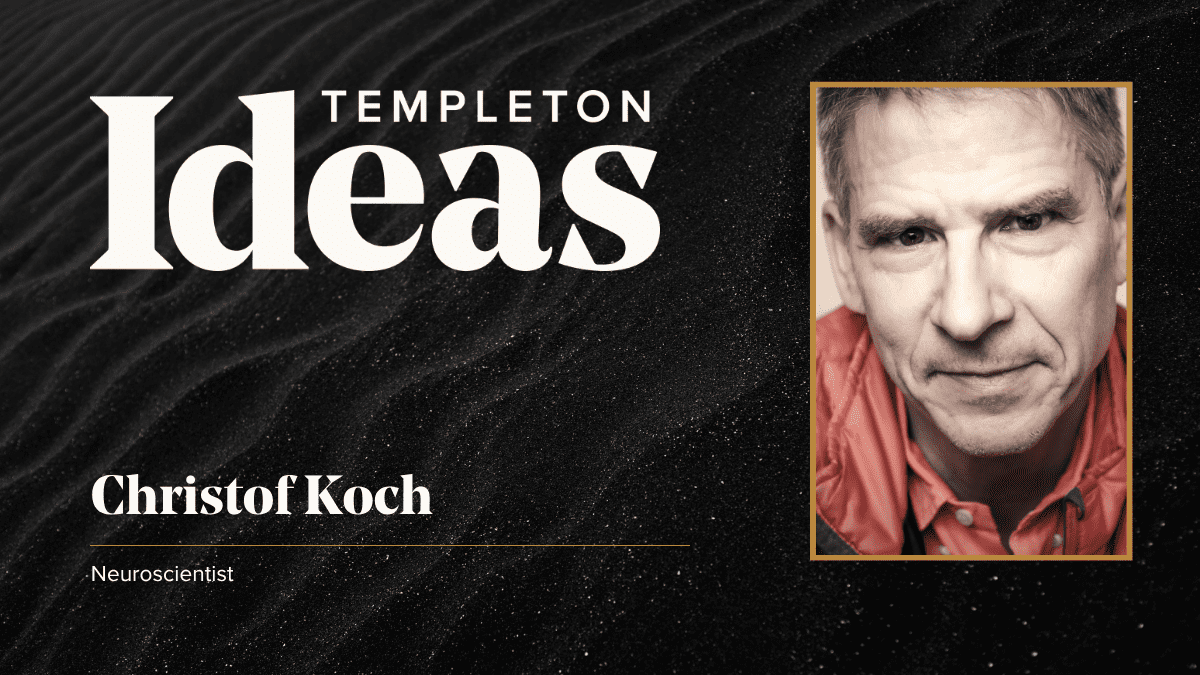
Christof Koch is a neuroscientist at the Allen Institute for Brain Science and the Chief Scientist of the Tiny Blue Dot Foundation. As a professor for 25 years at Cal Tech, he pioneered research on the neural basis of consciousness, and he has advanced one of the leading theories of consciousness called Integrated Information Theory. Among his many publications, Christof’s most recent book is entitled Then I Am Myself the World: What Consciousness Is and How to Expand It.
Transcripts of our episodes are made available as soon as possible. They are not fully edited for grammar or spelling.
Tom Burnett: Christof, welcome to the show.
Christof Koch: Thank you for having me, Tom.
Tom Burnett: Well, you started on your journey to understand consciousness decades ago. You had great scientific curiosity, a clear research agenda, worked on it with some of the most talented people in the world.
What also in terms of your kind of aspirations have you hoped to unpack by studying this thorny, fraught topic?
Christof Koch: I grew up as a devout Catholic in a devout Catholic family, but by the time I got my PhD, I was 24, and then I moved to MIT and then to Southern California, where I started working with Francis Crick.
The Nobel Laureate helped discover and decrypt the code of life, and of course, he was a committed atheist. And so at that point I didn’t think, at least overtly, about religious explanation anymore. They just didn’t seem adequate. But yeah, it’s well possible I was still driven by this need to understand the bigger picture.
You know, I wanted to know, are we just thrown in this senseless, purely material universe? We are complete strangers to this universe, and it’s all meaningless, or is there something more? That was probably one of the subterranean unconscious source of motivation. So I’ve always been driven by this desire to understand the mind-body problem, right?
How is it possible that three pounds of matter that in principle are no different from any other piece of furniture in universe, but this piece of matter can love and hate and dread and fear and want, see and hear, right? How is that possible?
Tom Burnett: One of the things I most enjoyed in terms of thinking about consciousness is the idea of having a machine, like a consciousness detector.
Does something like that exist in reality? And, and if so, how would it work?
Christof Koch: I started a company called Intrinsic Powers that is trying to bring a technique to do exactly that into an ICU n-near to you. The setting is the following. If one of us now has a cardiac arrest or a hemorrhage or I run into a truck, I’m brought to the ICU, I’m clearly alive, I’m typically on life support.
My eyes may be open, so I’m not in coma. So coma, typically your eyes are closed. There’s minimal, if any, reflexes. There may be some basic brain stem reflexes. But here you have people like Terry Schiavo, for instance, the eyes may be open two or three hours, and you ask the person, “Sir or ma’am, can you hear me?”
You pinch very hard the finger to try to see whether the patient will withdraw. You shine lights to see whether they will track the lights. They don’t do any of that. So these are called behavioral unresponsive patients, and they’re assumed to be unconscious. So this is now a practical tool that you can use in principle.
Patient comes in, they’re unresponsive. Well, first thing you’d wanna know, are they truly unconscious or are they just unable to respond? And this works similar, by the way, also in a closely related animal species like mice or rats, because most clinicians and neuroscientists assume it’s really the outermost layer of the brain, the neocortex that gives rise to feelings and memories and thoughts and notions of self, and the cortical architecture is similar across all these different animal species.
Now, we don’t know how this test would work with flies or with octopus, with other creatures, but at least in, in mammals, we seem to have a simple way to distinguish truly unconscious from conscious.
Tom Burnett: Yeah. During too, like if one could apply like anesthesia to a bird, measure something going on with the brain, and then measure it when it’s not under anesthesia as a way of just differentiating what state is it in.
Christof Koch: People do that all the time. Anesthesia is universal. You can anesthetize worms, you can anesthetize flies, you can anesthetize plants. They behave differently. And anesthetic is this near universal discovery almost 200 years ago that has all these huge clinical benefits, but we still don’t actually understand why is it so selective, because it seems to knock out consciousness safely, reversibly of course, very important, and relatively quickly, so they’re one of medicine’s greatest invention.
Tom Burnett: Yeah, it’s amazing the kind of universal applicability, that why would it work, and then what’s the difference?
Christof Koch: Probably so the assumption is because it’s so universal across the animal kingdom, it must reflect some very basic mechanism. It can’t be something that’s only present, let’s say, in us or in primates or something like that.
Tom Burnett: I’d ask you next about detecting consciousness in something utterly unlike us. So if at some point we have a digital device with artificial intelligence that insists that it’s intelligent or that it has an interior reality, how might you go about, in that kind of scenario, testing whether it is perhaps really conscious or a very, very clever simulation of consciousness, like a really, really great bot?
Christof Koch: It’s a very good question. Right now we don’t have a universal answer. Patients, it’s clear when they’re unconscious, this is conscious. Computers, of course, it depends on a lot of background assumption. So functionalism or computational functionalism assumes that if you can mimic the functions of something like the brain, then you can exhaustively describe the brain and all of its different functions Okay, so that’s a metaphysical belief that’s very widespread in academe and in big tech, and we’re now at a point, of course, with LLMs where they can certainly mimic our language, our linguistic ability to an amazing extent.
And, you know, people use now bots for friendship, for companionship, for romantic relation, for therapy, et cetera. I think that’s, of course, all deep fake, as your question seems to be applying. It’s deep fake. Just because they mimic us doesn’t mean that they are the same.
Tom Burnett: If I wanted to build an artificially conscious entity rather than thinking about I wanna build artificial intelligence, would I be better off trying to build on scaffolding of neurons?
Like, I’ve heard of brain organoids or some of these cortical carpets. Is that a way to strive towards consciousness more so than necessarily intelligence?
Christof Koch: Yes, because for one, we know that cortex is the substrate for consciousness, so if you can build these cortical carpets at a large enough scale, and you can recreate actually the milieu, including the excitability and the neurotransmitter, et cetera, of a normal brain, then yes, in principle, you might be able to achieve consciousness, including high consciousness.
In principle, most people would agree with that. The question is, is it as convenient? Can you manipulate it? Can you program it, et cetera? Those are all questions. And also, why would you wanna do it? We build AI because we want it to answer our questions and write reports and do email and all that stuff.
You can do all of that without feeling like something. Consciousness is really about feeling. It feels like something to be upset or hungry or talking to you. What’s the purpose of that? But if you wanted to, that’s one way to do it. The other way may possibly be quantum computers because if you have a bunch of entangled qubits, right, in principle, they’re all entangled with each other, so in some sense, they’re all one system.
They’re truly irreducible. And so that would lead to potentially very high-fi systems that are potentially quite conscious.
Tom Burnett: I wanna ask you about the pervasiveness of consciousness. We just a few minutes ago talked about how anesthesia works from humans, birds, mammals, reptiles, even worms. Perhaps consciousness might be some part of all these organisms.
I’m just curious from your vantage point, how far do you think consciousness goes in terms of the level of simplicity by which something might still have some kind of sensorium or experience, no matter how simple?
Christof Koch: Empirically, we simply don’t know. We assume it has to have eyes and a brain, certainly a nervous system, right, in order to feel like something So I would assume that a bee, bees have a million neurons compared to, you know, the 160 billion that humans have.
But actually the complexity of the neurons are actually higher by some measures per volume. It’s of course tiny under a milligram compared to our brain, but I assume it feels like something to be a bee. Not very complex, but it may be happy when it flies in the sun. It’s just gotten some golden nectar and flies back to its sisters back in the hive.
Now what about a single cell? In principle, if you look at a paramecium, it doesn’t have a nervous system because it’s a single cell, but it has already probably a trillion different tran- proteins, all of which interact in ways that are totally beyond our ability to currently describe or let alone model on a computer.
So there’s already vast untamed complexity, and it may well feel an itsy bit like something to be a single cell. And when it dies because its membrane has been disrupted, et cetera, then it wouldn’t feel like anything. Does it go even lower? Of course, there are these philosophies, panpsychism being the most dominant one that says it goes all the way.
Everything is endowed with both exterior and interior aspect. The exterior aspect is the one you can probe using physics and gravity, light and all of that. The interior aspect is what it feels like something. So your brain has exterior aspects. I can probe it, I can put it in a magnet, I can record brainwaves from it, but it also has an interior aspect.
That is how Tom actually feels at any given point in time. And does that extend throughout the universe? That’s really a metaphysical position. I think it’s certainly possible. There’s nothing in physics that I know that would say no, that’s not possible. What does it mean? We don’t know. So right now it’s more of a metaphysical speculation
Tom Burnett: It seems like we’re really doing a disservice to call any forms of life simple, because the closer you look, the complexity is there through and through in every form of life.
Christof Koch: Yes, all evolved systems are vastly complex, of completely untamed complexity that we find, as scientists, speology is very difficult to truly understand, and we of course see the signatures of this complexity everywhere, and, and the variability even in medical treatments.
That many medical treatments don’t work in most people. Any particular psychiatric treatment only works in 20 or 30% of people because we’re all different. We have different genes, we have different early childhood experiences, and all of it matters.
Tom Burnett: I’m wondering, I think if we find compelling the idea that consciousness is far more widespread than we had previously considered, I wonder about the particular case of humans.
I think in common parlance, we often associate consciousness so closely with humans, consciousness that distinguishes us. But if consciousness is pervasive, at least across forms of life, what is it that you think makes humans so peculiar, particular, and distinct in terms of how we behave?
Christof Koch: Human exceptionalism.
Look, it’s interesting. If you look at textbooks of neuroanatomy, they deal with different brain sizes, and of course, we all know that different animals have bigger brains. So the way people get around that, they invent these scales and then normalize them, allometric relationship, just to make sure that humans come on top because we know we are exceptional or unique, but I think that’s wrong.
That’s just an illusion. Every species is unique in what it does in its particular ecosystem. Now, we are unique in a sense that we’re the most aggressive, and we’re the most intelligent in some technical, uh, way, and so we dominate the planet. You could say one u- unique trait about us is true language.
You can train a chimp sort of to speak a few words, et cetera, but basically, you know, this enormous cognitive flexibility that most of us have in the form of language. But of course, it may also be our undoing.
Tom Burnett: So one has to recognize that each species, it has unique traits, and then one needs to need to identify, okay, we’re speaking of this species.
What is it that distinguishes it?
Christof Koch: And correct, and at the level of the brain, you know, if I take a little piece of brain from a mouse, a monkey, or a human, no one but an expert anatomist with a microscope can tell the difference. The basic architecture is the same. The number of genes across all mammals is very similar, 20,000.
The number of different cell types is very same, roughly 5,000. We have probably many more layers, but again, there might be some exceptions, like whales and elephants that really haven’t been studied very much because of their great size, and they also have these very deep, uh, neural networks. So I think it’s a fool’s game to look for what makes us exceptional.
Tom Burnett: So I’ve asked you about consciousness and how pervasive it can be, how simple it could be. I’m also curious about looking up in terms of ever greater complexity, greater consciousness humans haven’t achieved yet.
Christof Koch: So in principle, there’s, there’s no limit. So if, again, if humans, given the complexity of our cortex, we certainly seem to be more conscious of self.
But not all humans, not infants, not a late stage dementia patient, but m- most, you know, adult humans, you know, we have a sense of self. We know we’re gonna die. We know there was a world before we are born and all of that. But you can well imagine species either with technology or on a different evolutionary path that have even higher levels of self-consciousness.
That’s certainly imaginable Furthermore, academic literature is full of people who’ve had mystical experiences or overview experiences, if they’re astronauts, or near-death experiences or religious conversion experiences where they claim their conscious experience has vastly expanded. Psychedelic experiences is another case.
Particularly if you lose a sense of self, you have this experience that you’ve vastly expanded. In fact, in the limit of a true mystical experience, you feel this unity with everything. You feel suddenly you’re conscious of everything, and you are part of everything, and then it ends. Typically, these episodes are short, let’s say by the external clock, less than an hour, and you come back to the regular world.
But very often it leaves the person profoundly changed and transformed, and they will change very often their way of life, their way of thinking, their goals, what they should pursue, typically oriented towards a greater good because they had this experience that we are all one. This is very widespread in different religious tradition.
You can have it, of course, in Christian tradition, their mystics. In Buddhist tradition, during meditation, people can achieve these mystical states. Sufis achieve these mystical escapes. Indigenous cultures have them. So it’s very, very widespread that people report upon these mystical, expanded consciousness experiences that leaves a, a lasting trace in their life.
Tom Burnett: Yeah. It reminds me a conversation I had with Simon Conway Morris about the Fermi paradox and of why we haven’t encountered life elsewhere. He said, “Well, maybe we’re just not looking in the right place.” I wonder if it’s through exercising our conscious minds whether we might be able to touch a deeper reality.
Does that resonate with you at all?
Christof Koch: One interpretation of these mystical experiences relates to a philosophy that used to be very popular in the West, idealism, that ultimately what truly exists is some sort of cosmic mind at large. It may be some sort of consciousness, and the manifestation of the physical material universe that we can probe and test and measure with science is just a manifestation of something that ultimately is mental, and that during these mystical experiences, you can partake of that, and that is also from where you came before you were born, and this is also where whatever remains of your consciousness will go once you die.
So that’s a very different way of viewing It has many advantages. It’s fully compatible with science. It doesn’t deny that science works. It’s naturalism. It doesn’t assume there’s a greater God. So everything follows natural laws. We may not have access or even know the natural laws by which this underlying mental entity evolved.
We can study its manifestation in the physical universe, but in a sense, that’s sort of secondary to what truly exists, which is the phenomenon, mind at large.
Tom Burnett: I know you’ve committed your scientific career to specifically the study of neuroscience, the neural correlates of consciousness. I’m curious the degree to which having mystical experiences gives you insight into reality, maybe the same reality that science is trying to investigate.
Christof Koch: So I’ve had a mystical experience. It’s the most meaningful experience of my entire life. I’m still a scientist. So some people say science tells us metaphysically that only the physical exists. Now, I think that’s a claim that’s unsubstantiated. We don’t even know what the physical is, right? Particularly now with quantum entanglement, right?
If I can have two particles that are entangled, I move them half a universe away, and I, I observe one, and instantaneously the other one is determined, you know, that’s certainly not my grandfather’s physicalism or materialism anymore, and it’s pretty spooky stuff, which is why Einstein rejected it. So we should be very cautious of the metaphysical claims of science, but the empirical claims, they work and provable.
But, you know, there are many questions science can’t answer. Does my wife truly love me? Science is never gonna be able to answer that, or most questions of meaning, science is unable to answer. In particular, the question, what does it all mean and what truly exists? And for that, if you ever had such a mystical experience, those questions, as William James, the father of American psychology, already emphasized, he’s written this classical book, The Varieties of Religious Experiences, which talks about these mystical experience.
What’s characteristic from them, you bring back this feeling, this deep intuitive knowledge. I have seen the beating heart of the universe. I know now what it is. And you also bring back this great joy from this experience that pervades your entire life, and there’s a distinct, you know, before and afterwards.
So I think as Huxley said it in his book, it’s an unearned grace having such an experience.
Tom Burnett: What do you think stands out most in terms of the big perhaps pivots or maybe slower discoveries that you’ve made?
Christof Koch: Well, the consciousness that we can track its footprints in the brain, that this can lead to progress like in patients, right? So you probably know Templeton has funded these beautiful adversarial collaboration in the study of consciousness, but they have not led exactly to agreement.
But at least we now have tools because this is where the rubber of this abstract problem meets the road of existential question. Are we gonna pull your loved one? Are we gonna discontinue life support or not? It doesn’t get more real and more dramatic. The other thing, the discovery of these extraordinary experiences mediated partly through psychedelics And it’s really, as Michael Pollan has emphasized, most of us are at heart naive realist.
Um, right? We assume, well, there’s a world outside there, and then this world gets mapped onto my- the back of my mind cave, right? So I open my eyes, I see, I hear, et cetera, and it’s all very straightforward. But of course, we know for the past 200 years, and you, you can go back to Immanuel Kant, no, it’s nothing straightforward.
Your brain and your mind actively constructs perception. Any experience is an active construction. It’s based on various assumption that are encoded in my genes plus my early childhood, the biases I’m subject to, and we know this. The dress, for instance. Remember the dress, right? Half of humanity sees it blue, black.
The other one sees the dress as gold, white stripes. And people always ask me, “Well, Professor, what’s the real color?” There is no real color. There are photons of a particular wavelength that enter my eyes that, that can transform into something we have learned to call color. But that’s really a construct of your mind, and people have slightly different constructions.
And so it turns out here half the people see it one way and half the people see it other.
Tom Burnett: So I think in common parlance, people often use the term intelligence and consciousness sometimes interchangeably or maybe sometimes a little bit muddled. Do you think it’s important to differentiate or have a clearer relationship between intelligence and consciousness?
Christof Koch: It’s utterly critical. They’re very different things. Intelligence ultimately is about processing information, learning, adapting to rapidly changing environment. I don’t speak Russian. If somebody kidnaps me and puts me down in central Moscow, how do I adapt to this radical new situation? How quickly do I learn to adjust and all of that, okay?
And some people can do these sort of things better than others, and we call them high intelligent people versus low intelligent people, and we cherish it greatly in our society, and we pay people a lot of money for intelligence people, et cetera. Now, if you have a toothache, okay? So let’s imagine you really have a bad toothache, okay?
And it fills your entire consciousness. You can’t focus on anything else because this God awful pounding jaw. There’s nothing particularly intelligent about it. It’s not self-reflecting. It’s not mystical. It doesn’t tell you anything except this conscious experience fills your entire mind. So this just shows you one point here where consciousness ultimately is about being in pain, being in love, being bored, et cetera, while intelligence is about doing.
Now, in biological evolved creatures, they go together. So for example, take humans or you take closely related species, monkeys or dogs or cats, et cetera, most people assume that these animals are also conscious. Certainly I’ve never met a dog or cat owner who doesn’t assume, of course, a dog can feel pain and pleasure and can be joyful and can be depressed, et cetera.
And they are intelligent. I mean, not as intelligent as us, but they also have intelligence. But now with engineered system, you can get things like cerebral organoids that might be conscious in principle but have very little practical intelligence. And of course, you can get ChatGPT and LLMs, et cetera, right?
That looks certainly to be very intelligent, but we have no evidence whatsoever that they’re conscious. And at least conceptually, it’s really important to differentiate artificial consciousness from artificial intelligence.
Tom Burnett: And we’re in a age right now where we’re really sharply disentangling those two, which as you said, are often found closely intertwined in biology.
But with technology, seems like we’ve made enormous strides in artificial intelligence, but we may be at only the very inklings of developing any artificial consciousness.
Christof Koch: And there’s a big danger here because we tend to now, particularly in our capitalist society, we reward people and we reward algorithms, bots, for their intelligence, for their ability to do stuff Write emails, write stories, predict the financial market, et cetera, et cetera, right?
So that’s what we value, and we devalue states of consciousness. Yeah, you can go to yoga class and learn a little bit about mindfulness, but what we really value is doing things in the world. And to the extent that we value LLMs and agentic AI more and more, we’re gonna de-emphasize what’s really unique about us, which is the fact that we can love.
We can actually truly love other people or nature or other animals, et cetera, in a way that LLMs can’t, although they can of course claim to love. Why? Because they’ve been trained on every single human book. So of course they talk about it because they’ve learned to predict those words very well.
Tom Burnett: Yeah, it’s fascinating.
Degree to which we value performance, we invest our technological development in enhancing performance and intelligence. Degree to which we devalue conscious states, having a conscience and other such things, we don’t invest. And then you start seeing the two really separating from each other, right?
Christof Koch: And you, you can also see it now in people that begin to have real relationships where they’re emotionally invested with bots, right?
Now, you could say, okay, fine, if they feel happy about it and they’re not lonely, that’s good. But you wonder to what extent will then they be disappointed when they meet humans because humans never remember everything perfectly. They may be grumpy if you wake them up in the middle of the night, right?
Your bot is never grumpy. It’s always happy to serve you. And of course, they’re not nearly as sycophantic as AI tends to be. So again, that leads to a devaluing of human and human relationships and human experience.
Tom Burnett: Do you think consciousness requires a biological substrate? Does consciousness require neurons, or could consciousness be built from any kind of material?
Christof Koch: In principle, consciousness can be built from any type of material. I mean, a priori, there’s nothing magical. Same thing with life, the difference between organic and inorganic life, we don’t think there’s an additional magic substance, right, that’s necessary.
It’s just great complexity that’s present, so in principle, you could replicate that in other substrate. The question is, certainly according to integrated information theory, it’s the really, the causal relationship among the components that make up the physical substrate. And if you’re looking at the cerebral cortex, which in our case is the physical substrate, it has this amazing complexity where a single neuron may get input from 10 to 100,000 other neurons and project to 10 to 100,000 other neurons with these complicated synaptic weights.
So if you look at the combinatorial possibility of all the causal interaction with that, it vastly, vastly exceeds the ones that you would get in these endless fields of transistors that characterize digital computing machinery, where you have one transistor that talks to three or four other transistors.
Vastly less complex. And so the theory says, yes, electronic, in principle, could have high degree of consciousness, but in practice, the way they’re built now, no, would have exceedingly low measures of integrated information. In other words, it wouldn’t really feel like much. Other computers, like neuromorphic computers or quantum computers, could potentially be very, very different, but then they’re still in their infancy.
Tom Burnett: When you started down the path of the scientific study of consciousness, what did the field look like when you began? I’m imagining consciousness studies going from very unfashionable and shunned to, at least in increasingly big circles, a hot topic, something that’s very exciting.
Christof Koch: Brain imaging has made a big difference.
The fact that you can now sort of look at human brain while you play chess versus not playing chess, or you speak one language versus another language, or you see a woman face versus a, a male face, all of this will leave its traces in the brain, and seeing it, that’s really made a big difference. Now, two technological development, one is brain machine interfaces that you can begin to go into the brain, the human brain, not just the animal brain, and directly excite using electrodes or some other technology.
And then the questions around machine consciousness that’s really arisen now. It, it’s not science fiction stories that talk about it, but it seems to be here or almost upon us, so that’s really a big difference to even 10 years ago. So it’s exciting times.
Tom Burnett: Christof, this has been a wonderful discussion.
Thank you for joining me again.
Christof Koch: Thank you for having me, Tom.
Tom Burnett: We’ve come to the end of our miniseries on the nature of intelligence. In our four episodes, we’ve explored biology, AI, networks, neuroscience, and the mystery of consciousness. We’re gonna take a break for the summer, but we’re gonna be cooking up more Templeton ideas to share with you later this year. In the meantime, take care and enjoy your summer.
