

In our Study of the Day feature series, we highlight a research publication related to a John Templeton Foundation-supported project, connecting the fascinating and unique research we fund to important conversations happening around the world.
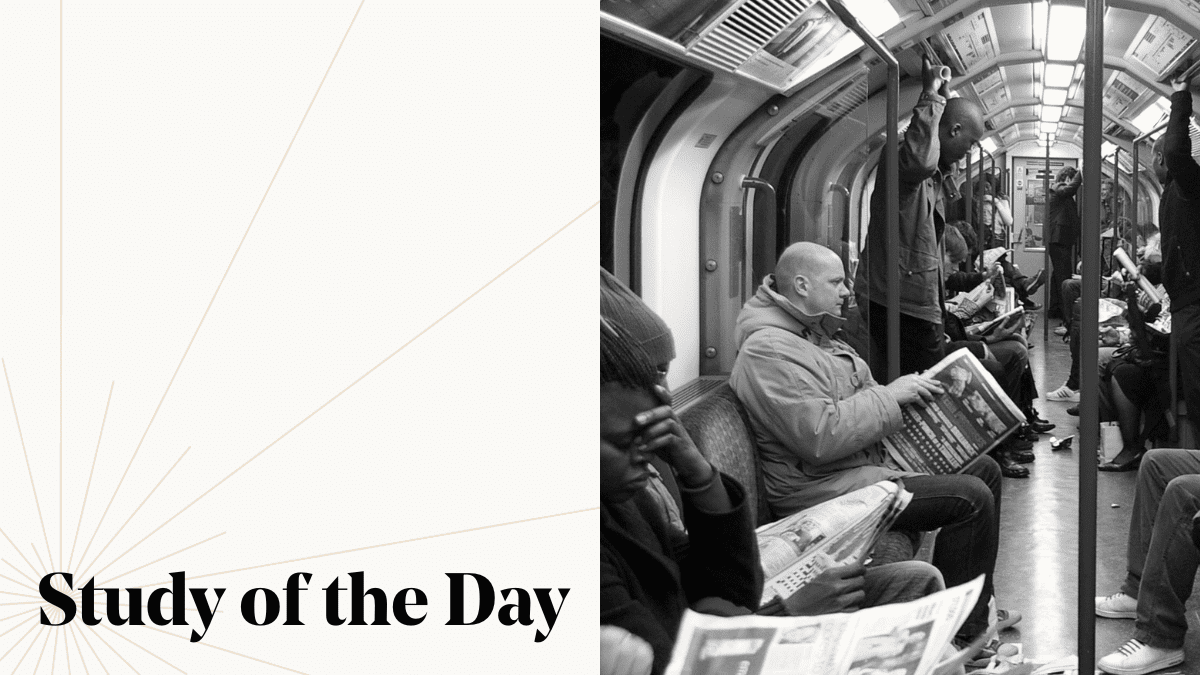
Around the turn of the millennium, a group of surveyors working under cultural sociologist Michele Gelfand interviewed more than 5,000 individuals in 33 countries to find out what they thought about the appropriateness of certain combined actions and contexts: Is it okay to laugh on the sidewalk? To sing at the movies? To bargain at a funeral? To read a newspaper during a job interview?
When the surveys came in, they crunched the numbers to see what people’s reactions revealed about each country’s cultural norms. The resulting paper, “Differences between Tight and Loose Cultures,” described a spectrum between tight cultures with strong norms and low tolerance for deviant behavior, and loose cultures with weaker norms and greater tolerance.
But how do these cultures, and their implicit norms, change over time? To find out, another group of surveyors, this time led by Kimmo Eriksson of the Institute for Futures Studies in Stockholm, Sweden, ran a new study based on Gelfand’s methodology to see whether the norms of acceptability and inappropriateness have changed. Their preregistered survey included more than 25,000 participants across 90 societies, gathering data about norms in 150 scenarios (15 behaviors multiplied by 10 situations).
They found that although cultures continued to vary in their relative tightness and looseness and their behavioral norms remained similar over time, there was nonetheless a global pattern of change toward more permissiveness over the past 20 years. Societies everywhere, it seems, have been getting a bit looser and more tolerant of individual self-expression.
Along with this global loosening of norms, though, came one important exception: a few kinds of behavior have grown even less acceptable over time.
Actions where an individual’s expression might have negative consequences for others have become less acceptable over the past two decades.
In nearly every society, they write, “norms have become more restrictive regarding arguing and flirting, while norms for crying, eating, listening to music on headphones, and reading the newspaper have become more permissive.”
To make sense of these shifts, the authors used Moral Foundations Theory, which distinguishes between individualizing norms centered around care, fairness, or liberty with binding norms that emphasize loyalty, authority, and purity. This approach identifies three categories of socially negative behavior: inconsiderateness (violating care), vulgarity (violating purity), and behaviors that just don’t make sense. Interestingly, the latter tend to be more of a problem in individualistic societies where people rely primarily on their own observations, rather than outside moral authorities, to judge behaviors.
The authors found that although societies still varied quite a bit on the individualizing-binding scale, they agreed quite a bit on the social meanings of situated behaviors, suggesting the existence of what they term a “global grammar of everyday norms.”
For example, it is generally agreed that kissing in a job interview elicits concerns about vulgarity, that laughing out loud in the library elicits concerns about inconsiderateness, and that reading the newspaper at the movies elicits concerns about lacking sense.
In their analysis, people’s attitudes towards scenarios identified as vulgar provided a surprising conundrum. As cultures shift towards emphasizing individualizing over binding norms, vulgarity, as a violation of purity, should become less of a concern. So Eriksson et al. had expected to find vulgarity to become more tolerable, not less so.
The results suggest that people, particularly from more individualized societies, are now viewing some vulgar scenarios as a form of indirect harm. They’re less worried about vulgarity being an affront to purity (“you’re embarrassing yourself”) than an assault on the value of care (“you’re making others uncomfortable”).
Still Curious?
Read Everyday norms have become more permissive over time and vary across cultures
Nate Barksdale writes about the intersection of science, history, philosophy, faith, and popular culture. He was editor of the magazine re:generation quarterly and is a frequent contributor to History.com.
