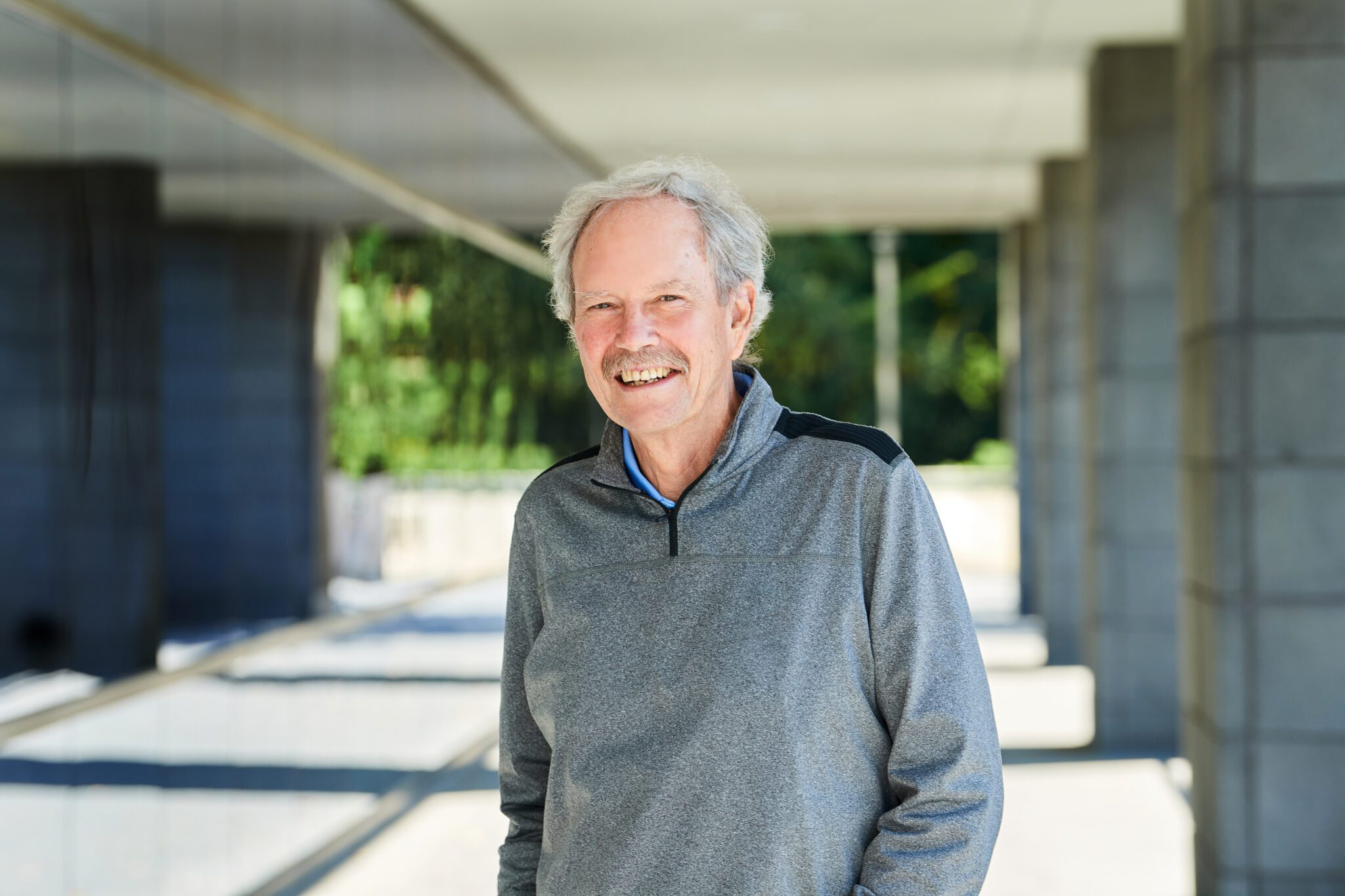
Hooke Professor of Experimental Physics and Pro-Vice Chancellor for Research at the University of Oxford. He read physics at Imperial College before moving to the U.S. to study for a Ph.D. in optical engineering at the Institute of Optics, University of Rochester, NY. Walmsley was a postdoctoral research fellow in electrical engineering at Cornell University and then joined the faculty at Rochester, eventually becoming director of the Institute of Optics. In 2001, he moved to Oxford as the Hooke Professor of Experimental Physics, and served as head of atomic and laser physics.
Hooke Professor of Experimental Physics and Pro-Vice Chancellor for Research at the University of Oxford. He read physics at Imperial College before moving to the U.S. to study for a Ph.D. in optical engineering at the Institute of Optics, University of Rochester, NY. Walmsley was a postdoctoral research fellow in electrical engineering at Cornell University and then joined the faculty at Rochester, eventually becoming director of the Institute of Optics. In 2001, he moved to Oxford as the Hooke Professor of Experimental Physics, and served as head of atomic and laser physics. He is currently Pro-Vice Chancellor for Research and University Collections at Oxford, with broad responsibilities at the institutional level for research across all academic disciplines, libraries, and museums. Walmsley's own research is in experimental quantum optics. This involves the study of non-classical states of light and matter and their interaction, with some view to applications in which quantum phenomena can provide enhanced capabilities over what is possible using the rules of classical physics. The particular expertise of his group is the application of ultrafast lasers to generate, manipulate, and detect small quantum systems, and currently has activity in the areas of linear optics quantum computing, quantum-enhanced precision measurement, coherent control of ultracold matter, attoscience, and ultrafast optical metrology. He has held visiting positions at universities in both Europe and the U.S.
After carrying out two years of field research on a ‘cargo cult’ in New Britain, Papua New Guinea in the late eighties, Whitehouse developed a theory of the role of ritual in group formation that has been the subject of extensive critical evaluation and testing by anthropologists, historians, archaeologists, and cognitive scientists. His most recent major project entitled ‘Explaining Religion,' focused on the psychological causes and consequences of religious thinking and behavior.
After carrying out two years of field research on a ‘cargo cult’ in New Britain, Papua New Guinea in the late eighties, Whitehouse developed a theory of the role of ritual in group formation that has been the subject of extensive critical evaluation and testing by anthropologists, historians, archaeologists, and cognitive scientists. His most recent major project entitled ‘Explaining Religion,' focused on the psychological causes and consequences of religious thinking and behavior. Funded by the European Commission and employing seven postdoctoral researchers in Oxford, this project involved collaboration with researchers at 14 universities across Europe and North America. Whitehouse is also studying religion from an evolutionary perspective with co-investigator David Sloan Wilson (Binghamton University), on a project funded by the Templeton Foundation. This research combines approaches from the cognitive sciences with Darwinian perspectives on religious evolution. Although an ethnographer by training and background, Whitehouse has for some years been using psychological experiments, economic games, large-scale surveys, and agent-based models to investigate various aspects of religious thinking. Together with psychologist Cristine Legare (University of Texas) he is currently undertaking experiments, funded by the McDonnell Foundation and the Fell Fund, to explore how children acquire and understand ritualized actions. Whitehouse is also interested in the prehistory of religion and makes annual visits to the Neolithic site of Catalhoyuk in Turkey where, in collaboration with archaeologist Ian Hodder (Stanford University) and others, he is seeking to discover how changes in the frequency and emotionality of ritual life relate to the shift from hunting and gathering to farming. From 2011-2016 he will be directing a new project on the causes and consequences of rituals in human societies. Funded by the Economic and Social Research Council, this project will use qualitative field research and controlled psychological experiments to examine how children learn the rituals of their communities and to explore the effects of ritual participation on ingroup cohesion and outgroup hostility. New databases will be constructed to explore the relationship between ritual, resource extraction patterns, and group structure and scale over the millennia. In recent years, Whitehouse has been heavily involved in the creation of new research clusters. He was founding director of the Institute of Cognition and Culture at Queen’s University Belfast and of Oxford’s Centre for Anthropology of Mind. In 2006, Whitehouse was elected to a newly created Chair in Social Anthropology at Oxford University and to a Professorial Fellowship at Magdalen College. From 2006-2009 he served as Head of the School of Anthropology.