



This summer, we’re offering reading recommendations on the theme of Intelligence. This is the first in a series of posts from the staff at the John Templeton Foundation. Enjoy!
 Superintelligence: Paths, Dangers, Strategies (Nick Bostrom, 2014)
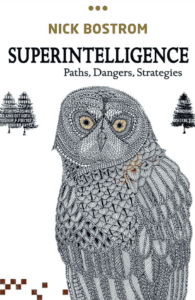 Superintelligence: Paths, Dangers, Strategies (Nick Bostrom, 2014)
Nick Bostrom’s Superintelligence is not an easy read, but it is a deeply rewarding one. It asks a question that once seemed remote, even fringe: What might happen if humanity created a form of intelligence that exceeded our own? One of the strengths of the book is that Bostrom does not limit himself to the AI systems of his own moment in 2014. Instead, he asks what could follow if any pathway (machine learning, biological enhancement, brain-computer interfaces, whole-brain emulation, or new forms of collective organization) eventually produced intelligence far beyond human capability. Some of these pathways now feel more speculative than others, especially in light of the extraordinary progress of large language models, but the deeper point still holds: the hardest questions begin after such a system exists.
Bostrom’s central concern is what he calls the “control problem,” now more commonly referred to as “AI alignment”: how can we ensure that a system vastly more capable than ourselves will pursue goals that remain compatible with human flourishing? His worry is not primarily about the familiar near-term concerns surrounding AI such as job displacement, misinformation, surveillance, or energy use. Rather, he is focused on existential risk: the possibility that a sufficiently powerful misaligned system could permanently alter, if not foreclose, humanity’s future.
What makes the book especially compelling is the way Bostrom proceeds with the care of an analytic philosopher, building arguments step by step, often through thought experiments, technical distinctions, boxed digressions, and precise conceptual maps. The result is that the book can feel dense, but also unusually clarifying. Even when the conclusions are unsettling, the reasoning is transparent enough that the reader can see how each claim follows from the last.
The book is also morally imaginative. Bostrom is not simply warning that “AI might kill us.” He asks what kinds of values we would want a superintelligent system to preserve, how humanity might coordinate under extreme technological pressure, and whether digital minds, if conscious, could themselves become subjects of moral concern. His discussion of “mind crime,” the possibility of causing suffering to simulated or digital minds, is a striking example of the book’s broader ethical reach.
Now over a decade after publication, Superintelligence has both aged and endured. Some of its technical expectations no longer map neatly onto the path AI development has taken. But its central achievement remains powerful: it challenges readers to consider the development of advanced AI not only as a technical feat, but as a profound civilizational and moral issue. For anyone interested in the long-term future of intelligence, technology, and human responsibility, this book remains one of the foundational works.