


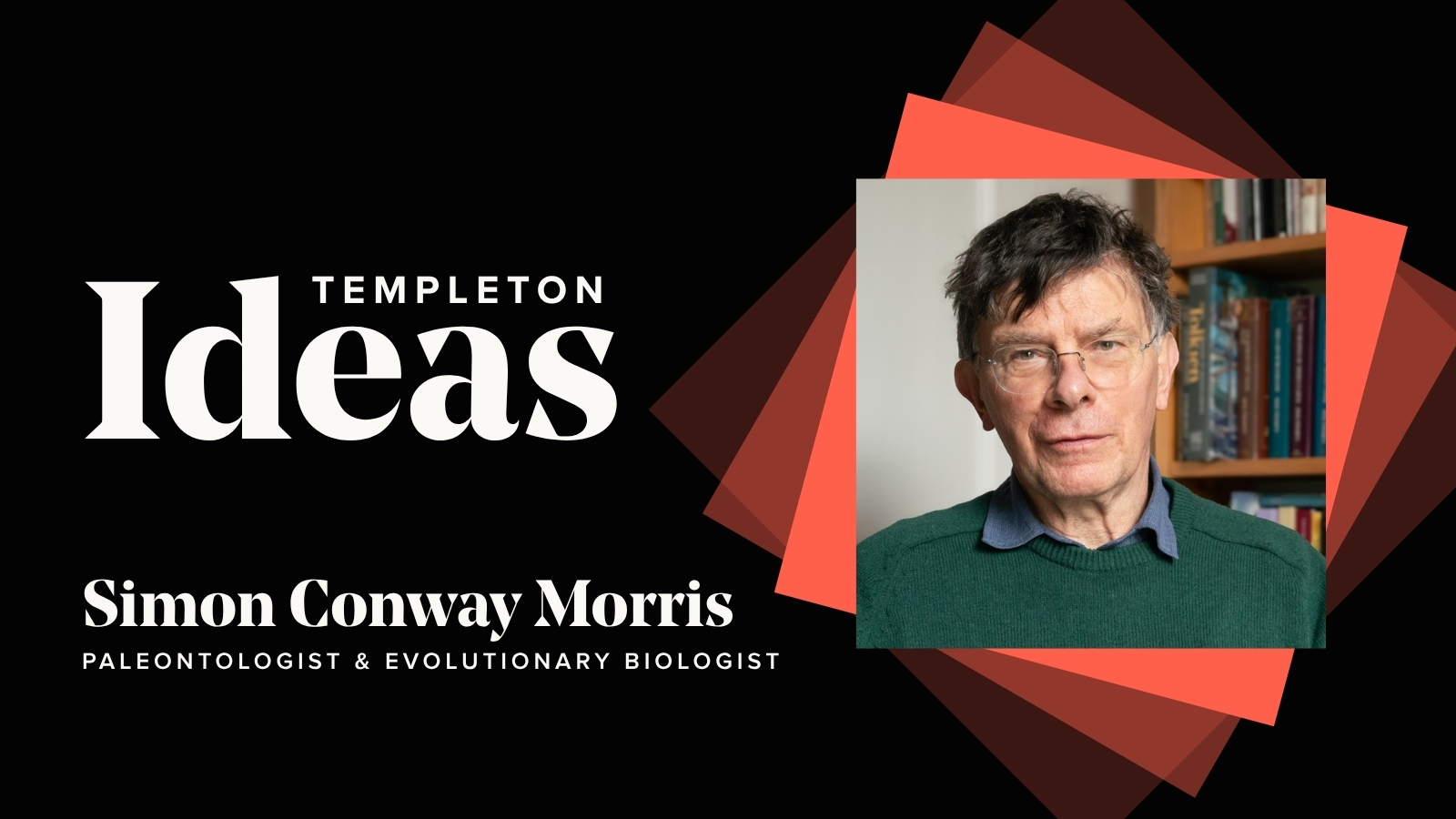
Simon Conway Morris is a paleontologist at the University of Cambridge. His research has illuminated the history of convergent evolution–the recurrence of similar biological features such as vision, wings, and even intelligence across vastly different evolutionary lineages. Through his popular books Life’s Solution, The Runes of Evolution, and From Extra-terrestrials to Animal Minds, he makes the case that convergence is not merely a series of curious coincidences, but evidence of a deeper order to biology.
Simon is a Fellow of the Royal Society and was just announced the winner of the 2026 Templeton Prize, a $1.4M dollar award for those who harness the power of the sciences to explore the deepest and most perplexing questions facing humankind.
Watch the Templeton Prize video, which explains Simon’s ideas, his biography, and the interesting parallels between cockroaches and dogs.
Transcripts of our episodes are made available as soon as possible. They are not fully edited for grammar or spelling.
Thomas Burnett: Simon, welcome to the show.
Simon Conway Morris: Thank you very much indeed.
Thomas Burnett: Well, Simon, you’re best known for your work on the Burgess Shale, and I think for our listeners who are not familiar with it, can you tell us what it is and what you found there?
Simon Conway Morris: Well, the Burgess Shale is a layer of sediment exposed in the Canadian Rockies uh, roundabout, I think 150 miles west of Calgary, and it’s of Cambrian age, therefore it’s about just over 500 million years old.
Thomas Burnett: And so there’s an area where it’s rife with fossils for discovery. What did you uncover? Literally speaking?
Simon Conway Morris: Well, when I worked on the fossils, most of my material was based in Washington DC so I spent a lot of time in the district. But the fossils themselves are extraordinary because if you go to any Cambrian outcrop, most likely you’ll find animals with their hard parts.
Trilobites, Brachiopods. In the Burges Shale it’s completely different. It is full of soft bodied creatures, which should not fossilize, but there they are staring at you. Fascinating.
Thomas Burnett: So you had this unique opportunity really to study these creatures that have features that are very rarely present to us 500 million years old.
What kind of high-level conclusions are you able to draw by such an unusual kind of evidence and artifact?
Simon Conway Morris: Well, apart from the fact that many of these fossils were just astonishingly well preserved, almost unbelievable, they represented a whole plethora of groups. Some were quite familiar, Annelid worms relative to the earthworm, but a whole set of other fossils, which at that stage seemed not to readily fit into the sort of taxonomic framework that the idea that they belonged to established groups, which we call phyla. So it appeared at least initially that the degree of diversity, which in fact is reflected overall in what we call the Cambrian explosion, was astonishingly large
Thomas Burnett: 500 million years ago. Incredible diversity of life. Is there an implicit inference that there is a great narrowing of diversity of life as time plotted on.
Simon Conway Morris: Not quite. If you go to Darwin’s origin and go to the only figure in it, right at the end, he’s got his depiction of ever greater diversity. And that indeed applies to the biosphere in the Cambrian there were no whales, there were no palm trees, for instance. So from our perspective, there’s much, much more.
But from another perspective, at least at that time, it looked as if there was really a remarkable range of diversities, which had not pulled through in the race for evolutionary success. And I ran with that. And indeed Stephen J. Gould, very distinguished Harvard paleontologist, wrote a very laudatory book about our work. Wonderful wife. But subsequently, and I’ve done this several times in my career, which is not always pleased certain people, I’ve changed my mind.
Thomas Burnett: Tell me a little bit more about that. What caused you to pivot? Because I think in a certain sense it reveals: Hey, I thought one way and I think I am arguing with myself and what I thought was the best judgment I’ve ever used.
Simon Conway Morris: Well, fortunately, most of the time I was not shouting into the mirror. In fact, a good deal of the work was the result of other people’s research, which showed that some of my conclusions were simply erroneous. And things, which I thought looked really strange. One of the animals, which has unfortunately become a bit too famous, we called Hallucigenia because of its dreamlike appearance, actually turned out not to be quite as weird as I thought to begin with.
And this actually sort of really replicated itself across my studies on the Burgess Shale and a whole lot of things, which at that stage really looked pretty strange, have now been fairly comfortably accommodated in known groups, which is actually what I should have realized at the beginning, but, you know, we were in a hurry and it was the first dip of the toe into the Cambrian ocean.
Thomas Burnett: Yeah. A lot of the value of working within a scientific community is there’s error correction, testing, a lot of stuff. It takes time to sort out and draw the best conclusions.
Simon Conway Morris: Well, I put it even more strongly than that.
And effectively the story’s never ending. And to a certain extent, I think not only has the Burgess Shale got similar deposits in Greenland where I worked and also in China where I’ve done a fair amount of work as well. And that’s very much sort of expanded the geographical range and to certain extent the time range as well.
But although there are lots and lots of new fossils, I think. We’ve got a reasonably secure understanding of what the diversity of life was like at that time, and it still remains very, very striking, the sheer range of forms. Each one actually, if you like, exploring a particular set of niches, but it’s all good evolution, that’s for sure.
Thomas Burnett: Yeah, so I’m wondering, worms from 500 million years ago are tough for me to fathom, to relate to. Can you help draw a connection for me between these creatures that existed so long ago in forms that we rarely give any thought to with the kinds of biology and life questions that we encounter today?
Simon Conway Morris: Well, I could perhaps give two examples. One is this group known as the annelids, which today are mostly familiar from the earthworm. But there are also many examples in the oceans. They’re called the Polychaetes and these effectively, the things in the Burgess Shale are not identical, but they’re pretty similar. And I think any biologist would recognize across the room, it’s not rocket science there.
Another example, which is still work in progress, is something which clearly some sort of chordate and we belong to the chordate. So from that respect, this is actually quite an exciting possibility that we’ve got some sort of. Ancestral form, but that actually is an animal called Pikaia Gracilens, and I’ve spent a lot of time working on it with Jean Bernard Carroll, a colleague of mine in Royal Ontario Museum.
I think everybody’s happy at some sort of chordate, but it’s still got a whole set of rather puzzling features. And this is still a matter of debate, and that’s absolutely what I want.
Thomas Burnett: Thinking about these long stretches of time, I think to me is often really overwhelming. I think it’s natural for us as humans to think in terms of narratives. As you’ve both investigated and reflected on deep history, how might you give, for instance, a narrative of the history of life, or if life were written like a book, what are some of its chapter headings that at least I could get a picture of?
Simon Conway Morris: Well, I suppose very crudely one would point out to the facts that to the first approximation about 700 million years ago, there were no animals at all or very few, but very primitive. Come the Cameron explosion, beginning perhaps 540 million years ago, then the most obvious manifestation and Charles Darwin recognizes immediately, and he refers to this in the Origin of Species, is the appearance of skeletons.
And now of course the Burgess Shale, if you like, literally fleshes all this out. And the marine story continues to the present day, of course, but then in due course roundabout the Late Silurian-Devonian land plants really become quite common. And in due course, the insects, as they became move on to land, they’re group known as the Arthropods and also another group of fish emerged and decided the fins were not so good on land, so let’s turn ’em into lakes.
And that’s basically what happens. I simplify slightly as a whole bag of fabulous evolutionary stories there as well. And then from that point on, of course, then the vertebrates, you know, some of them decided to crawl, some to slither, some to go back into the ocean and some indeed to take to the skies.
And that to happened many, many times independently.
Thomas Burnett: So from sea to land to air. The kind of basic framing is, is very helpful to me. I want to ask probe even deeper into deep time about the origin of life. And I’ve read that a lot of organic molecules have been found on things like meteorites that have hit the earth.
There’s organic materials seemingly throughout the universe, and from what I’ve read, some of the basic chemicals that comprise life themselves are fairly simple. They’re fairly present, but yet it seems like humans haven’t been able to, and it’s really hard to, create life, even if the ingredients are simple, like where are we stuck?
If we want to make something alive from the simple ingredients that we possess.
Simon Conway Morris: Well, to begin with, the basic building blocks of life. For instance, if you wanna make a protein, you’ve gotta have amino acids. And if you want to make a fat, then you need lipids and hydrocarbons and so on and so forth. And all those basic building blocks are pretty well ubiquitous, and they are formed as organic chemistry. But if you like, without the processes of life. So that’s fine and large.
And then one has a fair understanding of how these things might assemble to more complex things like a membrane or possibly a pre-protein like structure. But then the big leap is from that or those to something which is identifiable as a functioning cell.
In other words, something which has a metabolism, it has an interior factory involving energy transfer, and it also has to replicate itself. So we look of course traditionally to DNA, maybe before that RNA, but what exactly are the steps which led from the sort of metaphorical soup, which I don’t believe in for a moment, but something analogous to that, to a functioning cell is unsolved.
Thomas Burnett: Tell me about that. I love to think in terms of metaphors. It sounds like you’re uncomfortable with that metaphor, particular soup. Can you tell me more?
Simon Conway Morris: There are a whole set of plausible hypotheses, and my own hunch might be that if you want to have the origin of life, don’t stay on earth, go to a comet, because these are organic rich. We know that from the various probes which have visited them. And also, of course, most of the time they’re freezing cold, so the chemical reactions hardly proceed. But when they come close to the sun. The chemical reactions really take off. All sorts of things are going on, and then every now and again, part of a comet, a whole comet, collide to the planet like the earth, and then would deliver potentially protolife, if not protocells, if not cells.
Now, that’s only one possibility. There’s a far more heretical suggestion, which I don’t myself subscribe to perhaps, but let us suppose for the sake of argument, the universe is actually universal, that what we regard as a Bing Bang is not quite what people think it is. I’m not an astronomer, but let us just suppose that life was always there then, in which case we can push the answer back to infinity.
Now, I only mention that not because I think it’s correct, I think it’s most unlikely, but in the point of science, what one tries to do is imagine the unimaginable and just say, just suppose. And in terms of the transition from so-called abiogenesis to a functioning cell, I think all the practitioners freely admit that we do not have a satisfactory explanation, but it’s not a matter of defeat in the sense that we’ll never understand.
It simply means most likely, we’re looking in slightly the wrong place.
Thomas Burnett: I want to turn to a concept that you’ve articulated well in your books, Convergent Evolution. For those who are unfamiliar with it could you briefly describe what convergent evolution is, and maybe some prominent examples of it?
Simon Conway Morris: Convergent evolution is in some ways, entirely unexceptional. It simply observes from different starting points in the tree of life, although it’s a process of ever greater diversity, perhaps paradoxically, the end results as we see them today are strikingly similar, and I could give you hundreds of examples.
The last I’ve listed ’em in books I’ve written, my favorite example is that I am looking at the screen with a camera eye. If I was an octopus, I wouldn’t be sitting here at all, but I would still be using a camera eye. They’re almost identical. And the scientists would say, well, yes they are. And a very good reason for that ’cause that’s the way the eye works.
If you go into the details of it, actually, there’s some fascinating differences. The position of the retina, for instance, but that doesn’t really matter because what appears to be a disadvantage in our case, the retina is actually beneath the layer of cells in the octopus. It’s at the top of the layer of cells.
There are all sorts of clever ways in which there are modifications, which allow one to get round what appears to be a potential problem. So convergence really tells us that the number of tricks in life is much, much more limited than perhaps as once thought.
Thomas Burnett: And there’s maybe many different ways to get to the same destination.
Simon Conway Morris: Oh yes. I mean, with the eyes and point of fact, there’s something like 50 different sorts of eyes. So the so-called camera eye, which the human and the octopus have. But if you are an insect, you’ve got a compound eye. There’s lots and lots of lenses. That too has evolved a number of times independently.
It’s a good solution on its own scale, but certainly no good for a human. That there is a quite famous calculation, which pointed out that if the human had to have only a compound eye, it would have to have an eye, at least a meter across, which would well talk about getting through doorways and that sort of business. You know, it would be rather awkward, wouldn’t it?
Thomas Burnett: Indeed. Awkward indeed.
I remember from my high school and I guess some of my college textbooks on the subject of convergent evolution, see so many things I can kind of recognize physically, but as I read your books and saw your account, so many different kinds of examples I found remarkable the convergence around many different sensory organs, so vision as you’ve described, but also hearing, smelling, tasting, touch even maybe more exotic ones, echolocation, electromagnetic fields, and those are convergent as well.
And those aren’t the things that I can render well into a textbook image, but. Even in that space, do you see a lot of convergence?
Simon Conway Morris: Oh, I think one does. I mean, there are some examples. In the grand scheme of things, I’m very hard pushed to find anything which isn’t actually convergent in one form or other.
And these would extend all the way from molecular biology through to things like anatomies all the way through to social systems. And part of that argument would then extend in some form or fashion to brains and intelligence. Those two in various ways are convergent.
Thomas Burnett: So how does the study of these convergent sensory abilities, what does that tell us about the convergence of something that’s a little bit more intangible?
The convergence of mind, the convergence of intellect across a range of creatures.
Simon Conway Morris: Well, that’s an extremely difficult question. It is also involves areas of philosophy, which I’m not too familiar with. But in essence, I think the way I read it is that you have to have sense of the outside world. Otherwise, Darwin would say you’re dead. And that would be that.
And of course, if I’m a sperm whale diving a kilometer down, then. Vision isn’t much use down there, so let’s go for echolocation and so on and so forth. I think to the first approximation, very roughly, it doesn’t actually matter what sensory system you have other than it is channeled into various parts of the brain and it’s interpreted in some form or fashion.
And the fact that that turns out to be, what I would say is sight. I still regard as absolutely astonishing and people will make arguments it is computationally not so difficult. I dare say at one level that must be true. Otherwise, you know, things simply wouldn’t work. But behind that. At least as humans are concerned, of course, we have this intellect which is necessarily dependent on information from the outside world.
Thomas Burnett: Looking back, as you’ve done over long spans of time, what would you say, like how early in earth’s history would something that you describe as intelligence have emerged?
Simon Conway Morris: At one level, all life is intelligent.
All of it is making decisions, and it is basics on alternatives which have to be adjudicated. And there are certainly lines of evidence such as an interesting group called the slime bolts and not the sort of people who invite home on a day-to-day basis, but you can do sort of experiments where you can show that they have some sort of memory.
For example, and again, one has a tantalizing possibility that this is a very incipient stage of what we associate with our memory, and there must be some basis in that. But I would suggest the first approximation we can look at the birds, crows, parrots have relatively large breaks, and they do indeed seem to reflect this in their behaviors in one way or another.
Correspondingly amongst the vertebrates, especially the mammals, whales to some extent, elephants to some extent, notably the primates, of course, the chimpanzee, the orangutan and gorilla, they indeed seem to show many of the aspects which we associate with human sentience. But I perhaps mentioned earlier that I have a habit of changing my mind, and in this respect, I think I’ve, if not necessarily moved on, the degree of convergence is very striking, and one can use this to extrapolate this to perhaps the nature of extraterrestrials.
On the other hand, I’ve become increasingly interested, impressed, possibly even persuaded, by the uniqueness of humans, which have a series of features which we simply do not find in animals, most obviously language, most obviously technology. Where does all this come from?
Thomas Burnett: Does that level of cognition, that level of intelligence consciousness, does that depend on humans being primates?
Or maybe in principle, could another kind of mammal or another type of animal in other scenarios reach that point?
Simon Conway Morris: Well, with respect to convergent evolution, I think I’ve always tried to argue that I don’t really care what the group is at all. What I’m interested in is that sort of general profits of evolution, which in that sense is leads to a degree of predictability.
Now, it is the case that amongst the crows for example, which got relatively large brains, so there’s lots and lots of evidence to show that they’re pretty smart in all sorts of ways, and there’s little doubt there’s some connection there between this larger brain. And the fascinating thing is that with the brain structure, it’s radically unlike that which we see in the primates.
Despite that, more or less the same sort of intelligence emerges. So that too seems to be a sort of a universal property. So I would predict that there must be nervous systems in principle ’cause they’re possibly convergent and correspondingly they in due course will in many cases lead to something which we associate with a certain degree of smartness.
Thomas Burnett: So going back to that metaphor, there’s different ways to reach the same destination, even perhaps at the level of high intelligence.
Simon Conway Morris: It seems to be the case, yes. But as I said, when we come to the humans, we seem to have entered a completely new world. And I don’t find this actually particularly mysterious, but it’s, there’s a metaphysical argument here, which is nothing much to do with Darwin.
Thomas Burnett: Some combination of maybe over the last million years of biology and culture and this sort of back and forth and feedback between cultural developments changing your biology, the biology then changes culture, and once you’ve got these certain ingredients, then this explosion of you’re not sure what’s gonna come next, but the possibilities are you’ve reached a new vista or almost a play space of possibilities. So…
Simon Conway Morris: I think that’s very fair. I should add to that though, so far as we choose to define cultures in point of fact, you can identify cultures within chimpanzees. Chimpanzees have culture. But they may not know they have culture. This again seems to be the crucial difference.
There’s every reason to have cultural development. There may be a local environment which predisposes this group of chimpanzees to do termite fishing in this particular way. So that’s absolutely reasonable. But what we have now, of course, is a culture, which apart from anything else, allows us to step outside ourselves.
We are concerned how we look to other people, and we love going to the theater, and an animal would think it’s actually ridiculous. I mean, why watch a whole lot of humans wandering around on a piece of platform pretending to be other people? They said, this is a waste of time, isn’t it? When we think the exact reverse.
Thomas Burnett: I want to revisit a topic you brought up earlier in terms of search for life outside of our planet. It seems like you’ve given a lot of thought to this question of what’s described as Fermi’s Paradox. Could you describe what that paradox is first, and then maybe we can explore a little bit of it together?
Simon Conway Morris: Well, Enrico Fermi was a fantastically talented italian physicist and he fled Mussolini’s Italy with his wife who was Jewish. They came to the United States and he was a linchpin in the development of atomic energy and ultimately the Manhattan Project and the atomic bomb. And later on in Los Alamos, round about 1950, he’s sitting around with a whole lot of other people, all got brains the size of planets, incredibly clever people.
And he says as a throwaway line, “where are they?” Well, actually probably what he’s thinking about is how difficult is interstellar travel, but it’s now morphed into the general sense. Where are they? Why? Apparently, unless you’ve got some news for me at the moment, there is no detection of extraterrestrials. No signals, no sign of visitation in the fossil record, but it’s not quite as daft as it sounds.
So what’s going on?
Thomas Burnett: I find it fascinating too. A two-pronged approach to searching for life. One might say. It’s very unlikely that there could be something as highly intelligent. So our best bet is be looking for microbes. Let’s look at the chemistry of the atmospheres, these exoplanets, and cross our fingers that there is some sort of biological signature.
And then boom, we’ll have our evidence of life. And there’s other, it seems to me completely separate prong that thinks technology, as we’ve experienced is so rapidly progressing. It’s going to be the ultra advanced kind of technologies in which there could be communication, and then boom, we’ve got evidence of life, but that’s a utterly different form of life.
What should we be looking for if we want to detect other forms of life?
Simon Conway Morris: Well, there are several possibilities that are the most orthodox who simply to do what people are doing at the moment and investigating in so-called exoplanets and pretty well on the threshold of being able to interrogate the nature of the atmospheres.
And that should be a pretty sure far way of indicating whether it’s biology underneath. Those atmospheres, but another possibility is actually to throw all the existing thinking out of the window and just think radically different and say, well, let us suppose the sake of argument that what we are familiar with as sort of abstract potentialities, which we associate with literature, with poetry, with music, with mathematics, are all in their different ways telling you something profound about the nature of the universe. Presuppose that the realities we associate with day-to-day existence are indeed important, but they are only a very small fraction of what actually is there. So let us suppose that actually maybe through technological advance myself, I hope not, or in other ways one actually enters new dimensions of possibility and perhaps just perhaps that’s where we should be looking for the extraterrestrials.
But of course you will say, Simon, where’s the key? And I shall reply. Quite honestly, I haven’t got the foggiest idea.
Thomas Burnett: So do I understand you correctly that it might be in the frontiers of consciousness and of thought where we might want to look for the other versus looking at geometry and space.
Simon Conway Morris: Yes, I think that’s right. I mean, convergence in terms of big brains and those sorts of things and intelligence are I think, an important part of this ingredient. But the nature of consciousness, which again is one which has very many different ways of being interpreted. But to put it bluntly, I’m not a materialist of any sort at all.
Whereas I think most of my colleagues are, when it comes to what consciousness is, will say, well, it’s just there in the brain. A number of people, including myself, think this is so unlikely is to actually not be worth discussing. And most fascinatingly is, if you like the sort of alternative states one finds in conscious humans of one sort or the other.
I could touch on many of them. And one is a so-called placebo effect. Why is it that somehow the mind persuades itself it’s going to be made healthy on the basis of the injection of distilled water. Something’s happening there. And then there are other things like multiple personalities where you have several personalities in the same person.
And one famous example, the person was very, very allergic, let say to peanuts, but the other personality had no allergy at all. This is in the same body. So what on earth is going on here?
Thomas Burnett: I wonder if we’re in a period of time in which the openness to the kind of wider possibility space of what’s logical, not just what makes sense, if we’re kind of on the cusp of something.
Because I was talking to Christof Koch recently who I associate with someone who’s studying the neurological correlates of consciousness, but then I’ve heard him say recently, you know, I’m really much more open to a concept that ultimate reality might look more like idealism or panpsychism, where consciousness undergirds the physical space instead of sitting on top of it as a product of.
And I just thought if somebody who works on brain science for 30 years thinks that maybe reality might be mind, the sort of subjective experience of conscious minds, maybe anything’s possible at this point, do you see any shifting going on in the conversations that you’re having, in terms of what’s possible of what’s real.
Simon Conway Morris: I think perhaps a bit like the origin of life, there’s the sense that what we’re doing at the moment isn’t gonna get us as far as we would’ve liked. And I think this applies also to the study of consciousness.
Thomas Burnett: I want to come back to the topic of alien life and whether there’s life out there.
It’s a fascination, I think, both in the scientific community and in popular culture. And the question I have is what kind of inferences can we draw from the long, long history of life on earth and infer to something about life out there?
Simon Conway Morris: Well, my estimate is that if we visit an earth-like planet, and that’s a quite an important note of care, it will be like the earth. It will have forest, it will have oceans, it will have plants, therefore, and it’ll have marine creatures and they will often be streamlined because that’s the best way to do things if you want to be a shark or a whale or a tuna. And correspondingly on land, there will be many sorts of animals and they’d be chatting away to each other in one form or fashion.
But also they would be amongst this group of bipedal things which look astonishingly like humans. And all of this, of course, is predicated on the likelihood of convergence is indeed universal. Now, it could well be that in very extreme environments, perhaps very dense planets with lots of gravity available, then you have to change some of the rules.
But on the other hand, of course, perhaps this is just far too anthropomorphic. Perhaps my thinking is simply being channeled through terrestrial expectations, but given the physics of possibilities, given the chemistry of possibilities, given the way that bodies have to be made, I’m fairly confident that what we will find on these earth-like planets will be really pretty, pretty similar to what we have.
Not identical, heaven help us that would be a big surprise, wouldn’t it? But even so surprisingly similar.
Thomas Burnett: I’m glad you brought this topic up and that specification of earth-like planet. So I imagine in some other highly intelligent space-traveling creatures, whether they came to our planet a billion years ago when there were no animals, or if they came right now or if they came even, maybe a thousand years from now, which could be unimaginably different due to human technology from what we have now. If that’s almost like encountering three, just completely different realities, and they would draw three completely different conclusions from what they have in common, what they don’t, the degree of convergence or radical contingency.
What do we draw from these three different periods of Earth history and what that says about maybe life more generally.
Simon Conway Morris: Well, that’s a very fair summary. The problem is, if I may say with respect course to the last alternative, we haven’t got the foggiest idea so we can think about it, but who knows.
Where they to arrive today? One, imagine their technology such as it is, would be almost unimaginable. Arthur C. Clark makes this sort of point, but actually the first one is the most interesting, and this was something which I learned from a colleague, Charlie Lineweaver, who works in Australia, an American astronomer. And he and others have pointed out that actually many, many of the so-called extra solar systems, even in this galaxy, let alone elsewhere, have a headstart on our solar system of some billions of years.
So if all these things add together, let us say after three and a half billion years of evolution with a species which decides to go walkabout around the galaxy. Then we would’ve been visited, perhaps at the latest by the camian. I made this point many times in the past that they would come in a time with a burg of shale and they would see these little slippery things in the lagoon, uh, look suspicious like sardines and being sort of gastros apart from the else and also carrying a really well stocked seller of wine. They say, well, let’s see what these are like. So you know the out comes the barbecue kit and we, that is our ancestors, are there frying gently in the Cambrian sunlight. And that’s basically the end of us, I’m afraid to say, because one imagines then the whole history of that planet aka Earth was, it’s radically derailed.
Or maybe they just come in and have a look around and I’ve had a few other speculations in that area. But either way one would imagine that with this head start, then in one form or fashion, we really wouldn’t be here. But here we are.
Thomas Burnett: I want to explore a philosophical question. Humans have done some extraordinary studies, investigations, we can describe with mathematics, things that have happened billions of years ago. But one thing I think is, is so baffling is ourselves, the way we live, what we value, what we focus on day to day. Both the most spectacular things, whether aesthetics, ethics, athletics, you name it.
But we’re just so peculiar. If you compare us to any other creatures on this planet, what do you think of our universe from the fact that humans reside in it? In all of our diverse bizarre, wonderful and perplexing features.
Simon Conway Morris: From one perspective, when I see a little sort of image called a deep field photograph taken by Hubble or one of the more advanced telescopes, I do have a feeling of absolute vertigo.
It’s just. Unimaginably large and when they point out the size of the field relative to the size of the sky there, they all are galaxies upon galaxies. On the other hand, so far as we know, we are the only species has any comprehension of this and actually is, finds it all very interesting what these some of us do.
And that surely is the way to approach the question. It is, you know, what is it, which has our fascination and curiosity about the way these things are. Of course, and I remember startlingly once, I was in Namibia, where the southern sky and without the town lights, which polluted, uh, so much of our nights, I was awestruck, just gob smacked, just immense galaxies, you know, the, the Magellanic clouds and, and the Milky Way itself.
And it really was a symphony. Just, you know, sort of hats off, break into applause. And that’s the way I look at it. The very fact it’s all beyond our reach in a certain sense, and the fact it’s all happened billions of years or millions of years ago, that light crawls across the galaxy, there’s neither here nor there.
Thomas Burnett: Yeah. Pascal said something to that fact that I look at the vastness of the universe, I’m this tiny, tiny little reed and it just is so overwhelming. But then I realized, i’m a thinking read and, and my ability to engage with and imagine and reflect and explore that vastness is so cool. You’re flipping back and forth between insignificance to incredibly significant based on whether I’m thinking myself as particles that are momentarily in this arrangement versus thinking of myself as a thinking being that is trying to.
Comprehend this vastness.
Simon Conway Morris: And there’s another riff on that and it’s a long time since I read the book. I used to read it all times A teenager. It’s Olaf Stapleton’s, last and First Men. And as I recall, effectively its consciousness and intelligence, which its own way has a hand in controlling the way the universe evolves.
That too is a sort of suggestion that in the way that we’re embedded in the universe, it’s not simply as is sort of mid-sized ape which gazes at the sky. There’s rather more to it than that.
Thomas Burnett: Well, Simon, thanks for taking time to talk to me today. We’ve covered some really fun topics from both the deep past of Earth as well as far out into the most unimaginable stretches of the universe, and it is fun to go on that journey with you.
Simon Conway Morris: Thank you ever so much.
